

Reed Elsevier and Broken Hips
March 25, 2012
Break a hip when you are old and life gets really tough. Publishing companies like Thomson Reuters, Wolters Kluwer, and Reed Elsevier have taken their share of knocks and bumps. Now Reed Elsevier has a broken hip. The woes of scientific, technical, and professional publishers are like a bum ticker. Now a broken hip threatens the life expectancy and possibly the survival of the entity limping like Chester in Gunsmoke.
I am floating in the pond filled with mine drainage in rural Kentucky. It’s a good day as far as Kentucky goes. Even the hunters have taken a day off, so no sounds of gun fire roils the sylvan beauty of an abandoned horse farm. Yep, lots of horse farms for sale. The rich folks can no longer afford the sport of kings. Even kings and princes have had to cut back. What could be more enticing than a non working horse farm?
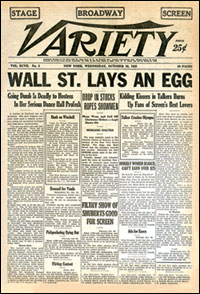
Oh, I have an idea. A traditional publishing company offering really high value properties like Variety, the must read newspaper of the Hollywood set. Wait. I am incorrect. I get Hollywood news from free Web sites; for example, E!Online, Celebrity Gossip, Entertainment Weekly, Hollywood Reporter, and TMZ.com. Granted a headline like “Ex Kony Soldier Warlord May Have Cursed Jason Russell” is not up to Variety’s headline writing, but it is free, has some exotic varietal images, and, of course, video and ads. Did I mention ads?
I learned about the new attempt to sell Variety in “Daily Variety Up for Sale.” Here’s the passage I noted:
It’s not the first time Reed has sought a buyer for its Hollywood newspaper. In 2008, the company put all of the U.S publications owned by its Reed Business Information unit up for sale. But amid that year’s financial crash, it was unable to find a buyer willing to purchase them all. Since then, the company has sold all of its other publications, including Publisher’s Weekly and Broadcasting & Cable. The move comes as Variety — famous for a show-biz lexicon of industry-specific terms like “boffo” and tongue-twisting headlines like “Sticks Nix Hick Pix” — has lost its standing as Hollywood’s dominant trade newspaper amid heated competition from online-only publications Deadline and the Wrap, as well as its traditional competitor, the Hollywood Reporter.
So now the economy is better and the market for print trade publications is apparently ripe for a sale of the property which “has lost its standing as Hollywood’s dominant trade newspaper” is on the block.
Several questions:
Amazon and Distribution Changes
March 23, 2012
Major online retailer, Amazon, is in the process of relaxing its policies regarding its ebook distribution. In the article “Amazon Publishing to Sell Series of eBooks Outside the Kindle Store,” we learn a little more about the decision to spread the wealth.
The recent retaliation of Barnes and Noble and other wholesale booksellers against Amazon has sparked a change in how Amazon will continue to do business. Barnes and Noble, as well as other booksellers, pulled the print editions of books published by Amazon Publishing from their shelves this month in retaliation to Amazon’s “Kindle store only” policy. It is a policy that Barnes and Noble management believes undermines the industry and creates monopoly.
In response to their action, Amazon announced that its latest series of short biographies will be sold outside of the Amazon marketplace. No word on whether the other stores will pick up the books but Amazon has assured the public that they want their books to be distributed as widely as possible.
Amazon has confirmed that its latest addition to the Amazon Publishing roster, a series of short biographies edited by James Atlas, will indeed be sold outside of the Amazon ecosystem in both print and ebook form.
Why is it that Amazon is ridiculed for its apparent lack of availability when Apple has long had a foothold in the marketplace as a “buy here, pay here only” business? Apple products are available at your nearest electronics provider (as are Amazon Kindles). Yet when it comes to content, you must go through iTunes in order to utilize all aspects of your product.
We think that a distribution shift is an important part of access. Are consumers and search lost in the mulcher?
Stephen E Arnold, March 20, 2012
Sponsored by Pandia.com
Quote to Note: Publisher Strips the Internet Bare
March 15, 2012
Quote to Note. Interesting write up by a poobah fearful of losing his elephants. Point your vile browser thing at “John R. MacArthur: Internet Con Men Ravage Publishing.” Here is the quote I noted:
As far as I know, there isn’t a single profitable online-only magazine or newspaper in the United States and there isn’t a single profitable newspaper or magazine with an online edition that is seriously considering dropping its print edition.
The write up was free when I located the essay. I don’t have much of an opinion on the arguments in the poobah’s write up. Too late.
Stephen E Arnold, March 15, 2012
Sponsored by Pandia.com
Library Association Flexes Its Muscles
March 15, 2012
The American Library Association had plenty to say to publishers about the recent inflation of ebook prices. In “Libraries Protest Random house Price Hike” we get a more in depth look at the problem.
The Random House publishing company recently informed libraries that the wholesale price for ebooks would be on the rise by more than 20 percent. That’s a huge hike increase for something with no tangible, physical, product attached to it. The increase would affect new adult releases and children’s ebooks would double.
This new protocol stems from the publishers believe that ebooks can be “repeatedly circulated” without wearing out. Barring file destruction, they can be circulated indefinitely.
This comes as a shock to most libraries around the country. Many local branches are going through a tough year as finances that were already spread thin are stretched to the limit due to stiff budget cuts across the board. The publishers actions have caused the American Library Association to stand up and defend its right to fairly priced goods and the patrons rights to indefinite circulation.
While I appreciate Random House’s engagement with libraries and its commitment to perpetual access,” ALA president Molly Raphael said in the statement, “I am deeply disappointed in the severe escalation in e-book pricing reported today. Calling on our history together and our hope to satisfy mutual goals moving forward, the American Library Association strongly urges Random House to reconsider its decision. In a time of extreme financial constraint, a major price increase effectively curtails access for many libraries, and especially our communities that are hardest hit economically.
But while the move comes at a bad time for libraries in a financial bind, and is certainly not in good taste, it’s hard to blame a company that is worried about its own future both physically and financially for trying to cover all of its bases and make a buck or two where it can. In an age where technology is taking over, books and other forms of leisure have been relegated to the back burner as the latest and greatest craze takes over. We’ve seen companies like Sony and Kodak go bankrupt or nearly so and discontinue the production of their most trusted moneymakers. Is it too farfetched to think that novels have become a novelty?
Stephen E Arnold, March 15, 2012
Sponsored by Pandia.com
Is Copyright Shifting Direction?
March 15, 2012
It is tough to search when content is not there. We have been alerted to the threat of censorship from lawmakers by conflicts over legislation such as SOPA, PIPA, ACTA and TPP. We must not ignore a more insidious threat: that of direct dealings between copyright industries and Internet service providers at the behest of government; so warns TechDirt in “UK Government Pressuring Search Engines to Censor Results in Favor of Copyright Industries.”
Rather than laws that would have to be enforced through legal channels, the back-door “notification” system described in the article would submit blacklists to search engines. These lists would name sites accused of infringement, which would then be barred from search results. Any accusation could doom an entire site to obscurity, possibly without recourse. Whitelists of approved media services would also be provided and those sites artificially promoted within search results. Writer Glyn Moody asserts:
Absolute power over search engines’ results in these areas would be handed to industries that hardly have a good track record for adopting a proportionate approach to tackling unauthorized downloads. In particular, they are unlikely to lose much sleep over all the legitimate content that will become invisible when sites of borderline legality are removed from search engines’ results ‘just to be on the safe side.’ And there are no indications that there would be any oversight as to who goes on the lists, or any right of appeal — making it a purely extra-judicial punishment.
It seems that most search engines are balking at the proposed arrangement, for now at least. Moody notes that complying with white lists could be considered anti-competitive and get sites in trouble with the European Commission. Yes, that would be important. Perhaps it is a sign that the whole scheme is a bad idea? How will the legal spat between India, Google, and Facebook work out? Our view: not well.
Cynthia Murrell, March 15, 2012
Sponsored by Pandia.com
More on the Ignorance of Online Users
March 12, 2012
Some folks do not recall the Frenchman who toured the US. A couple of centuries ago, the notion of democracy worked out to a C average. There were some A students and some Fs. But the logic, as I understood the Frenchman, was blah. You may want to refresh your memory of Democracy in America, but may be not. There are basketball games to watch and Peyton Manning’s peregrinations to follow.
I read “Nick Denton on the “‘Tragedy of the Comments’” and thought about how “easy” search, business intelligence, and finding pizza have become. Even conference organizers take the C or average approach, preferring to use the same speaker in several different sessions. Hey, the person is an expert and it is much easier to sign up speakers if we recycle “proven performers”.
Here is a passage from the Denton item which caught my attention:
Once upon a time, in the early days of blogging, Gawker founder Nick Denton said, publishers hoped that the Web would help them “capture the intelligence of the readership.” But now? “That’s a joke,” he said. “That didn’t happen,” Denton said at South by Southwest, in a conversation with blogger and entrepreneur Anil Dash. “It’s a promise that has so not happened that people don’t even have that ambition any more.” The hope was that the Internet would boost the quality of public conversation and let writers and readers collaborate on stories, but instead, he said, there’s been a “tragedy of the commons… or tragedy of the comments.”
Fascinating shift from confidence in any one creating content to a more traditional view. The idea that a poobah knows best seems to be roaring back. It is probably good to be a poobah or at least to think that one is one. Who will be the next William Hearst?
Stephen E Arnold, March 12, 2012
Sponsored by Pandia.com
Exogenous Complexity 5: Fees for Online Content
March 7, 2012
I wanted to capture some thoughts sparked by some recent articles about traditional publishing. If you believe that the good old days are coming back for newspapers and magazines, stop reading. If you want to know my thoughts about the challenges many, many traditional publishers face, soldier on. Want to set me straight. Please, use the comments section of this Web log. —Stephen E Arnold
Introduction
I would have commented on the Wall Street Journal’s “Papers Put Faith in Pay Walls” on Monday, March 5, 2012. Unfortunately, the dead tree version of the newspaper did not arrive until this morning (March 6, 2012). I was waiting to find out how long it would take the estimable Wall Street Journal to get my print subscription to me in rural Kentucky. The answer? A day as in “a day late and a dollar short.”
Here’s what I learned on page B5:
As more newspapers close the door on free access to their websites [sic], some publishers are still waiting for paying customers to pour in.
No mention of the alleged calisthenics in which the News Corp.’s staff have undertaken in order to get a story. But the message for me was clear. Newspapers, like most of those dependent on resource rich, non digital methods of generating revenue, have to do something. In the case of the alleged actions of the News Corp. I am hypothesizing that almost anything seems to be worth considering.
Is online to blame? Are dark forces of 12 year olds who download content the root of the challenges? Is technology going to solve another problem or just add to the existing challenges?
Making money online is a tough, thankless task. A happy quack to http://www.calwatchdog.com/tag/sisyphus/
My view is that pay walls are just one manifestation of the wrenching dislocations demographic preferences, technology, financial larking, and plain old stubbornness unleash. The Wall Street Journal explains several pay wall plans; for example, the Wall Street Journal is $207 a year versus the New York Times’s fee of $195.
The answer for me is that I did not miss the hard copy Wall Street Journal too much. I dropped the New York Times print subscription and I seem to be doing okay without that environmentally-hostile bundle of cellulose and chemically-infused ink. Furthermore, I don’t use either the Wall Street Journal or the New York Times online. The reason is that edutainment, soft features, recycled news releases, and sensationalism do not add value to my day in Harrod’s Creek, Kentucky. When I look at an aggregation of stories, sometimes I click and see a full text article from one of these two newspapers. Sometimes I get the story. Sometimes I get asked to sign up. If the story displays, fine. If not, I click to another tab.
When I worked at Halliburton NUS and then at Booz, Allen & Hamilton, reading the Wall Street Journal and the New York Times was part of the “package”. Now I am no longer a blue chip “package.” I am okay with that repositioning. The upside is that I don’t fool with leather briefcases, ties, and white shirts unless I have to attend a funeral. At my own, The downside is that I am getting old, and at age 67 less and less interested in MBA wackiness. I have no doubt I will be decked out in my “real” job attire. For now, I am okay with tan pants, a cheap nylon shirt, a worn Reebok warm up jacket, and whatever information I can view on my computing device.
Newspaper publishing has not adjusted to age as I have. Here’s a factoid from my notes about online revenue:
When printed content shifts to digital form, the online version shifts from “must have” to “nice to have”. As a result, the revenues from online cost more to generate and despite the higher costs, the margins suck. Publishers don’t like to accept the fact that the shift to online alters the value of the content. Publishers have high fixed costs, and online thrives when costs are driven as low as possible.
Net net: Higher costs and lower revenue are the status quo for most traditional publishers. Sure, there are exceptions, but these are often on a knife edge of survival. Check out the hapless Thomson Corp. Just don’t take the job of CEO because it is a revolving door peppered with logos of Thomson and Reuters and financial results which are deteriorating. Think Thomson is a winner? Jump to Wolters Kluwer, Pearson, or almost any other “real” publishing outfit. These are interesting environment for lawyers and accountants. Journalists are not quite as sanguine as those with golden parachutes and a year or two to “fix up” the balance sheets.
Resistance Emerging to Sci Tech Publishing Status Quo
March 6, 2012
More hassles are brewing for Elsevier Science, as We, Beasties discusses in “The Future of Science Publishing.”
Since the earliest scientific journals began being published in 1665, their key position in the field of science has grown exponentially. They have become so integral that it is nigh impossible to build a successful career as a scientist without publishing in them. The publishers of these journals vigorously guard their territory; even now, they are throwing their weight behind the Research Works Act, a proposed US law that would nullify the current mandate: that any scientific data derived from public funding must be made available to the public within one year of publication. So, we helped pay for the research, but wouldn’t be able to read the results without paying again? Hmph.
Prominent mathematician Timothy Gowers has had enough such tactics, and has begun a publishing boycott of Elsevier, one of the largest journal publishers. If such a boycott expands to all the publishers, and it might, those who participate will risk prestige and grant money until the system changes. How many will take such a risk?
We, Beasties writer Kevin presents his own vision of a post-journal-centric field:
“In my idyllic world, every lab has their own blog, and publishes their results in real time, sharing them on a site like ResearchGate. Individual figures can be indexed on something like FigShare. Scientists can post their negative or confusing data and ask the entire world for help, or talk about their research plans and get critiqued. Meanwhile, altmetrics are being generated in real time to assess the validity of data, and scientists peer review on their own blogs or at some central location. The distribution of scientific knowledge returns to the model of the 19th century – free and openly distributed – but now also instantly and globally distributed at the same time.”
Sounds great. Will grass-roots action by scientists be enough to break the stranglehold of entrenched science publishers like Elsevier?
Cynthia Murrell, March 6, 2012
Sponsored by Pandia.com
About.com: Digital Fail?
February 22, 2012
At a time when most things digital are booming, one company trying to build a digital strategy is failing magnificently.
The New York Times announced that About.com has suffered a 67% drop in profits and that revenues are falling as well. The New York Times acquired the site in 2005 when About.com was one of the hottest sites on the Internet and has recently been trying to create a digital strategy based on high-quality content. However, according to a recent article, “The New York Time’s About.com: From All-Star to Albatross,” the change is quite visible. We learn:
… it’s unclear if About is still viable as a brand. While the company launched a marketing campaign in 2010 to differentiate it from other ‘how-to’ sites, there’s little evidence the message resonated with users. While readers may seek out individual About “guides,” the 80% search traffic figure reflects how About remains a detour not a destination for the vast majority of visitors.
The company attributes the change to Google’s decision to downgrade the company’s pages in its search results. Plausible, but I also feel the need to note that nothing digital seems to work at this outfit. Fascinating. Perhaps the company should look internally for the issue.
Andrea Hayden, February 22, 2012
Sponsored by Pandia.com
Online and Medicine: Responsibility Falls on Customer
February 19, 2012
Sunday morning in Harrod’s Creek. Reasonably quiet for now. Gun fire will crackle when the sun rises. Police sirens will howl as some Commonwealth residents crash their cars after a late night run on the Bourbon Trail.
These are consequences of human choices. Guns do not fire themselves. Automobiles, at least so far, do not drive themselves.
Two stories caught my attention, and the way in which an “issue” was handled by writers and their publications make clear the odd handling of human intent.
First, navigate to “Infants’ Tylenol Recalled.” The hook is that a large company, Johnson & Johnson, manufactured or caused to be manufactured a medicine which can do harm not good. I do not know if the story is accurate, but it contains an interesting passage:
Company officials say in some cases the flow restrictor was pushed into the bottle when inserting the syringe. The recall applies to one-ounce bottles of grape flavored Infants Tylenol Oral Suspension. There have been no adverse events from the problem according to McNeil.
So no adverse effect to a child given Tylenol. Okay, the company is not chastised, nor is the article placing blame. On the surface, it seems that the company facing the allegation took action were it not for this statement: “Recall-plagued Johnson & Johnson is pulling all infant Tylenol off the U.S. Market.” So somewhere in this recall story people made decisions and people did the alleged action to put infants at risk.
Now point your browser thing at “Google’s Privacy Invasion: It’s Your Fault.” The story addresses the allegation that either Apple or Google took competitive actions. The online customer, in my opinion, is a clueless about the risk of certain online actions as is an infant taking medicine. Note what the “real” journalists at InfoWorld offer:
No, let’s put the blame where it belongs, on us, the users of the Internet. We rely on free services like Gmail while insisting on “privacy,” a term that we probably can’t even define to our collective satisfaction. We accept terms of service contracts and privacy policies that explain in excessive detail how we will not get privacy, how our information will be used, and then we object.
So instead of privacy, let’s talk about control. You do have some of that, still. Make some choices about how your information will be used–because it will be used–instead of accepting default settings.
Okay, online customers are at fault. Why are both stories giving the entities facing these allegations such gentle treatment. Humans make decisions at companies which have an impact on consumers who assume, trust, or expect products to work without a problem.
I find this interesting because as products and services become more complex, those using the problems are making decisions which deliver customer satisfaction. Maybe customer satisfaction is not a priority? Maybe journalists are finding it easier to ignore or shift the blame?
Fascinating. When one tries to search for information about these matters, the content which surfaces is not about the deeper problems. When content is removed or shaped, the “facts” of an issue become secondary to the spin. “Consumers, it is your fault” becomes the reality. I don’t believe this assertion for one New York minute. And pharma companies? Yikes.
Stephen E Arnold, February 19, 2012
Sponsored by Pandia.com
-

- Subscribe to Beyond Search
Feature archive
News archive

-


