

Cision: More Data from Online Monitoring
March 1, 2021
Cision calls online monitoring “listening.” That’s friendly. The objective: More particular data to cross correlate with the firm’s other data holdings. Toss in about one million journalists’ email addresses, and you have the ingredients for a nifty business. “Brandwatch Is Acquired by Cision for $450M, Creating a PR, Marketing and Social Listening Giant” says:
Abel Clark, CEO of Cision said: “The continued digital shift and widespread adoption of social media is rapidly and fundamentally changing how brands and organizations engage with their customers. This is driving the imperative that PR, marketing, social, and customer care teams fully incorporate the unique insights now available into consumer-led strategies. Together, Cision and Brandwatch will help our clients to more deeply understand, connect and engage with their customers at scale across every channel.”
Cision data may open some new markets for the PR outfit. Do you, gentle reader, law enforcement and intelligence professionals would be interested in these data? Do you think that Amazon might license the data to stir into its streaming data market place stew?
No answers yet. Worth “monitoring” or “listening.”
Stephen E Arnold, March 1, 2021
Microsoft LinkedIn: Opting and Gigging
February 25, 2021
Microsoft LinkedIn has determined that its millions of job seekers, consultants, and résumé miners can become gig workers. “LinkedIn Is Building a Gig Marketplace” asserts:
LinkedIn is developing a freelance work marketplace that could rival fast-growing gig sites Fiverr and Upwork. The two-sided marketplace will connect freelance service providers with clients in need of temporary workers for one-off projects. Like Fiverr and Upwork, it would focus on knowledge-based work that can be done remotely online…
How long has Microsoft LinkedIn been contemplating this shift? One date offered in the article is 2019. That’s when LinkedIn acquired UpCounsel. The idea is that when one needs a lawyer, one uses a legal version of Match.com. Very me-too. Thomson Reuters offers a service called FindLaw.com, which has been available since the early 2000s. But good ideas take time to gestate. This is not a me too knock off of TikTok which has inspired Facebook and Google innovation. LinkedIn innovated with ProFinder. This is a way for LinkedIn members to find “professionals.”
Sounds good, right?
Writer Joan Westenberg is over LinkedIn, and advises us we would all be better without it. The Next Web posts, “Delete LinkedIn—You’ll Have Zero F****ing Regrets.” After years of enduring countless messages from those who want to sell her something, she finally deleted her LinkedIn account. Not only did the platform fail to provide her any professional benefits, she was also disheartened by the superficial relationships with her hundreds of contacts. (At least this platform does not call them “friends.”)
Having had some success at sales for her business, Westenberg has observed that the way to sell to someone is to build a real relationship with them. Her favorite way to do so is to offer help with no agenda, to demonstrate her products have value. She writes:
“That is the antithesis of LinkedIn. Where people send you off-brand and clumsy sales pitches at best — or at worst, scrape your details for scalable and utterly useless outbound campaigns. They send pitch decks in the same breath that they introduce themselves for the first time. They want you to buy with no reason why. LinkedIn feels less like a platform for selling, and more like a platform for being sold to. A LinkedIn message is the 2020s equivalent of a cold sales call. You dread it. You hate it. You just don’t want to deal with it. … I would rather focus my attention on platforms where I know people have come to genuinely research, interact, learn and consume. Quora. Angel List. Dribble. Medium. Substack. And yes, Twitter. And I would rather remove the false sense of accomplishment we get from engaging on LinkedIn, where we log into a landfill of utter [excrement] several times a day and feel like we’ve done our bit of networking and growing, with no evidence to support that belief.”
Westenberg advises others to join her in ditching the platform. All we will lose, she concludes, are the vanity metrics of clicks, likes, shares, and comments, all of which provide nothing of value. Hmm. I for one have never gotten a job through the platform, but I do know someone who has. Then there are all the professional courses the platform acquired when it snapped up Lynda.com in 2015, many of which are quite helpful. I suppose each user must weigh the site’s role in their professional lives for themselves, but on this point I agree—LinkedIn is not fundamental to professional success.
Cynthia Murrell, February 25, 2021
Microsoft GitHub Goodie: Social Profile Finder
February 22, 2021
Do you want to locate the social media profile of a person? How about locating that social media profile across several hundred online services? Sounds good, doesn’t it? You can try this open source tool by navigating to Social Analyzer, downloading the code, and reading the documentation. Is this open source software as good as some of the tools available from specialized service providers? The answer is, “In some situations, it’s close enough to horseshoes.” The GitHub information says:
This project is “currently used by some law enforcement agencies in countries where resources are limited”.
Do some commercial specialized services providers charge their customers for access to this tool? Does Vladimir Putin have a daughter who is an expert dancer?
There are some interesting functions in this open source package; for example:
- Email detection
- Use of OCR to make sense of content in images
- String and entity name analysis.
Having a user name and password for each system may come in handy as well. Microsoft is a helpful outfit in some ways.
Stephen E Arnold, February 22, 2021
A Classy Approach to Editorial Controls
February 2, 2021
Off and on over the decades, I have worked with some publishing outfits: Some were big with lawyers and accountants turning the screws on those far down in the hierarchy. Others were small, operating out of offices the size of a shipping container in a run down neighborhood in Boston. I even worked for a “real” newspaper, hired by the eccentric owner Barry Bingham Jr. to assist the then nationally recognized Courier Journal to succeed in the electronic information sector in 1981. After the break up of the newspaper, I ended up working in a techno business role at a big time New York City publishing company.
But in my professional career, I can state with reasonable confidence that I have not heard editorial control processes described as methods to deal with “daily active sh*t heads.” The quote appears in this story: “Reddit’s CEO Has a Colorful Nickname for the Redditors Who Ruin It for Everyone.” If the individual identified in the write up did make this statement, the word “colorful” does not aptly characterize the situation.
Here’s my take:
- Online information platforms use 230 as a way to dodge responsibility to deliver useful information provided in exchange for some value (ads, subscriptions, donations, etc.)
- Editorial controls should have been implemented the day the service went live in 2005 or so, not 15 years later. The accountability clock seems to be running or stopped.
- Users has always reminded me of those addicted, but “sh*t heads is neither appropriate nor accurate. With appropriate controls developed since our pal Gutenberg made waves, the craziness was neither necessary or facilitated.
Net net: The “sh*t heads” in this situation are the managers who abrogated their responsibility to deliver useful, accurate information. (By the way, Reddit is a hot bed of quite fascinating content, and that content can be manipulated by skilled bad actors.”
As I said, Reddit, not its users, are those with heads comprised of a substance some find offensive. Users, before you think I am okay with you, an editorial process would block or marginalize your rejected information so that you were encouraged to find a more companionable outlet for your thoughts, dreams, fetishes, hopes, and inner psychological voice.
Stephen E Arnold, February 2, 2021
Common Sense via a Survey: Social Media and Kiddies. Guess the Results?
January 29, 2021
I read “Social Media Damages Teenagers’ Mental Health, Report Says.” I had a college professor who loved studies like this. Grant money. Demonstrate the obvious. Write a research paper. Get more grant money. Repeat.
The write up reports:
Teenagers’ mental health is being damaged by heavy social media use, a report has found.
Yikes! Who knew?
Here’s what the academic wizards unearthed, almost the discovery of the Twitter and Facebook era, and I quote:
- One in three girls was unhappy with their personal appearance by the age of 14, compared with one in seven at the end of primary school
- The number of young people with probable mental illness has risen to one in six, up from one in nine in 2017
- Boys in the bottom set at primary school had lower self-esteem at 14 than their peers.
I wonder if the youthful person wearing fur and horns in the US Capitol a couple of weeks ago is a manifestation of delayed youth.
On the other hand, mobile neck has become a thing. Quite surprising that social media is not the wonderland of community and positivity that some folks assumed.
Imagine that! Assume. Ass of you and me, according to another instructor in college who seemed less inclined to research common sense under a grant umbrella.
Stephen E Arnold, January 28, 2021
Online Axiom: Distorted Information Is Part of the Datasphere
January 28, 2021
I read a 4,300 word post called “Nextdoor Is Quietly Replacing the Small-Town Paper” about an online social network aimed at “neighbors.” Yep, just like the one in which Mr. Rogers lived in for 31 years.

A world that only exists in upscale communities, populated by down home folks with money, and alarm systems.
The write up explains:
Nextdoor is an evolution of the neighborhood listserv forthe social media age, a place to trade composting tips, offerbabysitting services, or complain about the guy down the street whodoesn’t clean up his dog’s poop. Like many neighborhood listservs,it also has increasingly well-documented issues with racial profiling, stereotyping of the homeless, and political ranting of variousstripes, including QAnon. But Nextdoor has gradually evolved into something bigger and more consequential than just a digital bulletin board: In many communities,the platform has begun to step into roles once filled by America’slocal newspapers.
As I read this, I recalled that Google wants to set up its own news operation in Australia, but the GOOG is signing deals with independent publishers, maybe the mom-and-pop online advertising company should target Nextdoor. Imagine the Google Local ads which could be hosed into this service. Plus, Nextdoor already disappears certain posts and features one of the wonkiest interfaces for displaying comments and locating items offered for free or for sale. Google-ize it?
The article gathers some examples of how the at homers use Nextdoor to communicate. Information, disinformation, and misinformation complement quasi-controversial discussions. But if one gets too frisky, then the “seed” post is deleted from public view.
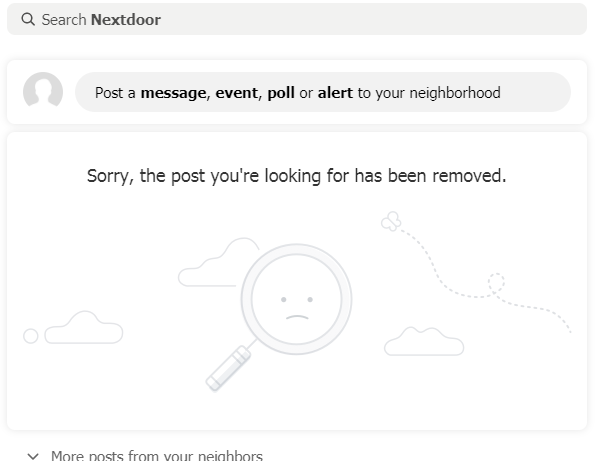
I have pointed out in my lectures (when I was doing them until the Covid thing) that the local and personal information is a goldmine of information useful to a number of commercial and government entities.
If you know zero about Nextdoor, check out the long, long article hiding happily behind a “register to read” paywall. On the other hand, sign up and check out the service.
Google, if you were a good neighbor, you would be looking at taking Nextdoor to Australia to complement the new play of “Google as a news publisher.” A “real” news outfit. Maybe shaped information is an online “law” describing what’s built in to interactions which are not intermediated?
Stephen E Arnold, January 28, 2021
TikTok: The Fluttering Sound Is Hand Waving
January 13, 2021
I read “TikTok: All Under-16s’ Accounts Made Private.” The write up explains:
TikTok users aged under 16 will have their accounts automatically set to private, as the app introduces a series of measures to improve child safety. Approved followers only can comment on videos from these accounts. Users will also be prevented from downloading any videos created by under-16s. TikTok said it hoped the changes would encourage young users to “actively engage in their online privacy journey”.
That sounds good. But is it the sound of hand waving in the thick atmosphere of appearing to do something when nothing is really being done?
Questions the Beeb’s write up sparked are:
- How will TikTok know the verifiable age of a new user?
- How will TikTok know if an over age user pays an under age user to create an account?
- How will TikTok verify that “all” accounts are made private?
- Won’t system administrators and others have access to these data?
Flutter, flutter, flutter.
Stephen E Arnold, January 13, 2021
Facial Recognition: Not As Effective As Social Recognition
January 8, 2021
Facial recognition is a sub-function of image analysis. For some time, I have bristled at calls for terminating research into this important application of algorithms intended to identify, classify, and make sense of patterns. Many facial recognition systems return false positives for reasons ranging from lousy illumination to people wearing glasses with flashing LED lights.
I noted “The FBI Asks for Help Identifying Trump’s Terrorists. Internet (and Local News) Doesn’t Disappoint.” The article makes it clear that facial recognition by smart software may not be as effective as social recognition. The write up says:
There is also Elijah Schaffer, a right-wing blogger on Glenn Beck’s BlazeTV, who posted incriminating evidence of himself in Nancy Pelosi’s office and then took it down when he realized that he posted himself breaking and entering into Speaker of the House Nancy Pelosi’s office. But screenshots are a thing.
What’s clear is that technology cannot do what individuals’ posting to their social media accounts can do or what individuals who can say “Yeah, I know that person” delivers.
Technology for image analysis is advancing, but I will be the first to admit that 75 to 90 percent accuracy falls short of a human-centric system which can provide:
- Name
- Address
- Background details
- Telephone and other information.
Two observations: First, social recognition is at this time better, faster, and cheaper than Fancy Dan image recognition systems. Second, image recognition is more than a way to identify a person robbing a convenience store. Medical, military, and safety applications are in need of advanced image processing systems. Let the research and testing continue without delay.
Stephen E Arnold, January 8, 2021
Social Media Is Allegedly No More Addictive Than Other Fun Activities
December 10, 2020
Thumbtypers, rejoice.
Documentaries are informative films that tell factual stories, but they are edited to tell the most entertaining story to earn money. Netflix recently released the The Social Dilemma documentary that explains how Facebook is an addictive activity. People are now ranting about social media addiction, but they have been doing that for years. Axios states humans become fearful about addiction with every new media technology, like the novel. Read more about the so called “addiction” in: “The Social Media Addiction Bubble.”
There is no denying that social media can be addictive. The same can be said for other media technology: videogames, TV, Internet. Addiction is a problem, but labeling something as an addiction does not help find solutions. Psychology professionals have not created an official “Facebook addiction” diagnosis, however, there is a Bergen Facebook Addiction Scale that determines individuals’ dependency on social media.
Facebook addiction is a subset of Internet addiction. Social media and technology experts do not want their creations to cause harm. For the most part, social media does not cause harm. Projecting fear onto information media is a “moral panic” and masks bigger issues. There is usually something else that is the root of addictive behavior whether it is in the form of depression or simple escapism:
“Addiction theories also promote a sense of powerlessness by imposing “all or nothing” thinking, as sociologist Sherry Turkle argued in her 2011 book “Alone Together.”
• “To combat addiction, you have to discard the addicting substance,” Turkle wrote. “But we are not going to ‘get rid’ of the internet. We will not go ‘cold turkey’ or forbid cell phones to our children…. The idea of addiction, with its one solution that we know we won’t take, makes us feel hopeless.”
Our thought bubble: Addictions typically are driven by an effort to numb pain or escape boredom, and solutions need to address demand for the addiction, not just the supply.
• People with fulfilling jobs, healthy families and nourishing cultures are a lot less likely to get addicted to Facebook or anything else.”
It is easier to blame something that is a tool and easily controllable than focus on the deeper issues behind the underlying behavior. Cars cause accidents, pollute the environment, and drain natural resources. Cars, though, are a tool and are not the underlying problem behind death, pollution, or depletion. The problem is humanity. How to fix the problem? You repair human habits by addressing what is wrong.
Whitney Grace, December 10, 2020
LinkedIn Analyzed: Verrry Interesting
December 4, 2020
I read “LinkedIn’s Alternate Universe.” I was poking around in an effort to find out how many social profiles are held by Microsoft. The write up provides a number 722 million. However, for my purposes I used a less robust estimate of 660 million. I ran out of space for decimal places. Check the story on Monday, and you will understand my space challenge. The story is Disinterest in Search and Retrieval Quantified.
I recommend this Divinations’ write up because it is amusing, and it helped me understand why the service has become some what peculiar in a social network world in which Ripley’s Believe It or Not! content has become normative.
Here are three examples:
- Posts by living people announcing that the author is dead. Ho, ho. Alive, not dead for the denizens of a personnel department site.
- Begging for dollars and attention. The two seem to be joined at the medulla for some LinkedIn members.
- The antics of recruiters become Twitter jokes.
What is fascinating is that we have a WordPress plug in that posts headlines to LinkedIn automatically. This creates some interesting reactions. First, the software bot has about 800 LinkedIn friends. Okay. I think that’s good. Second, the stories about the MSFT social network service have been filtered as I recall.
The article is worth a gander.
Stephen E Arnold, December 4, 2020
-

- Subscribe to Beyond Search
Feature archive
News archive

-


