

Paranoia or Is it Parano-AI? Yes
April 22, 2024
 This essay is the work of a dumb dinobaby. No smart software required.
I get a kick out of the information about the future impact of smart software. If those writing about the downstream consequences of artificial intelligence were on the beam, those folks would be camping out in one of those salubrious Las Vegas casinos. They are not. Thus, the prognostications provide more insight into the authors’ fears in my opinion.

OpenAI produced this good enough image of a Top Dog reading reports about AI’s taking jobs from senior executives. Quite a messy desk, which is an indicator of an inferior executive mindset.
Here’s an example: “Even the Boss Is Worried! Hundreds of Chief Executives Fear AI Could Steal Their Jobs Too.” The write up is based on a study conducted by Censuswide for AND Digital. Here we go, fear lovers:
- A “jobs apocalypse”: “AI experts have predicted a 50-50 chance machines could take over all our jobs within a century.”
- Scared yet? “Nearly half – 43 per cent – of bosses polled admitted they too were worried AI could take steal their job.”
- Ignorance is bliss: “44 per cent of global CEOs did not think their staff were ready to handle AI.”
- Die now? “A survey of over 2,700 AI researchers in January meanwhile suggested AI could well be ‘better and cheaper’ than humans in every profession by 2116.”
My view is that the diffusion of certain types of smart software will occur over time. If the technology proves it can cuts costs and be good enough, then it will be applied where the benefits are easy to identify and monitor. When something goes off the rails, the smart software will suffer a set back. Changes will be made, and the “Let’s try again” approach will kick in. Can motivated individuals adapt? Sure. The top folks will adjust and continue to perform. The laggards will get an “Also Participated” ribbon and collect money by busking, cleaning houses, or painting houses. The good old Darwinian principles don’t change. A digital panther can kill you just as dead as a real panther.
Exciting? Not for a surviving dinobaby.
Stephen E Arnold, April 22, 2024
Can Your Job Be Orchestrated? Yes? Okay, It Will Be Smartified
March 13, 2024
 This essay is the work of a dumb dinobaby. No smart software required.
My work career over the last 60 years has been filled with luck. I have been in the right place at the right time. I have been in companies which have been acquired, reassigned, and exposed to opportunities which just seemed to appear. Unlike today’s young college graduate, I never thought once about being able to get a “job.” I just bumbled along. In an interview for something called Singularity, the interviewer asked me, “What’s been the key to your success?” I answered, “Luck.” (Please, keep in mind that the interviewer assumed I was a success, but he had no idea that I did not want to be a success. I just wanted to do interesting work.)
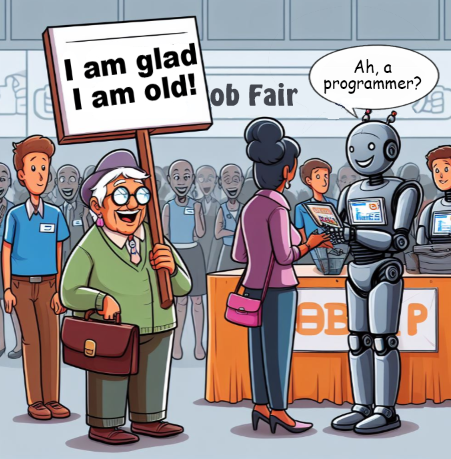
Thanks, MSFT Copilot. Will smart software do your server security? Ho ho ho.
Would I be able to get a job today if I were 20 years old? Believe it or not, I told my son in one of our conversations about smart software: “Probably not.” I thought about this comment when I read today (March 13, 2024) the essay “Devin AI Can Write Complete Source Code.” The main idea of the article is that artificial intelligence, properly trained, appropriately resourced can do what only humans could do in 1966 (when I graduated with a BA degree from a so so university in flyover country). The write up states:
Devin is a Generative AI Coding Assistant developed by Cognition that can write and deploy codes of up to hundreds of lines with just a single prompt. Although there are some similar tools for the same purpose such as Microsoft’s Copilot, Devin is quite the advancement as it not only generates the source code for software or website but it debugs the end-to-end before the final execution.
Let’s assume the write up is mostly accurate. It does not matter. Smart software will be shaped to deliver what I call orchestrated solutions either today, tomorrow or next month. Jobs already nuked by smartification are customer service reps, boilerplate writing jobs (hello, McKinsey), and translation. Some footloose and fancy free gig workers without AI skills may face dilemmas about whether to pursue begging, YouTubing the van life, or doing some spelunking in the Chemical Abstracts database for molecular recipes in a Walmart restroom.
The trajectory of applied AI is reasonably clear to me. Once “programming” gets swept into the Prada bag of AI, what other professions will be smartified? Once again, the likely path is light by dim but visible Alibaba solar lights for the garden:
- Legal tasks which are repetitive even though the cases are different, the work flow is something an average law school graduate can master and learn to loathe
- Forensic accounting. Accountants are essentially Ground Hog Day people, because every tax cycle is the same old same old
- Routine one-day surgeries. Sorry, dermatologists, cataract shops, and kidney stone crunchers. Robots will do the job and not screw up the DRG codes too much.
- Marketers. I know marketing requires creative thinking. Okay, but based on the Super Bowl ads this year, I think some clients will be willing to give smart software a whirl. Too bad about filming a horse galloping along the beach in Half Moon Bay though. Oh, well.
That’s enough of the professionals who will be affected by orchestrated work flows surfing on smartified software.
Why am I bothering to write down what seems painfully obvious to my research team?
I just wanted another reason to say, “I am glad I am old.” What many young college graduates will discover that despite my “luck” over the course of my work career, smartified software will not only kill some types of work. Smart software will remove the surprise in a serendipitous life journey.
To reiterate my point: I am glad I am old and understand efficiency, smartification, and the value of having been lucky.
Stephen E Arnold, March 13, 2024
Remember Ike and the MIC: He Was Right
January 9, 2024
 This essay is the work of a dumb dinobaby. No smart software required.
It used to be common for departing Pentagon officials and retiring generals to head for weapons makers like Boeing and Lockheed Martin. But the hot new destination is venture capital firms, according to
the article, “New Spin on a Revolving Door: Pentagon Officials Turned Venture Capitalists” at DNYUZ. We learn:
“The New York Times has identified at least 50 former Pentagon and national security officials, most of whom left the federal government in the last five years, who are now working in defense-related venture capital or private equity as executives or advisers. In many cases, The Times confirmed that they continued to interact regularly with Pentagon officials or members of Congress to push for policy changes or increases in military spending that could benefit firms they have invested in.”
Yes, pressure from these retirees-turned-venture-capitalists has changed the way agencies direct their budgets. It has also achieved advantageous policy changes: The Defense Innovation Unit now reports directly to the defense secretary. Also, the prohibition against directing small-business grants to firms with more than 50% VC funding has been scrapped.
In one way this trend could be beneficial: instead of lobbying for federal dollars to flow into specific companies, venture capitalists tend to advocate for investment in certain technologies. That way, they hope, multiple firms in which they invest will profit. On the other hand, the nature of venture capitalists means more pressure on Congress and the military to send huge sums their way. Quickly and repeatedly. The article notes:
“But not everyone on Capitol Hill is pleased with the new revolving door, including Senator Elizabeth Warren, Democrat of Massachusetts, who raised concerns about it with the Pentagon this past summer. The growing role of venture capital and private equity firms ‘makes President Eisenhower’s warning about the military-industrial complex seem quaint,’ Ms. Warren said in a statement, after reviewing the list prepared by The Times of former Pentagon officials who have moved into the venture capital world. ‘War profiteering is not new, but the significant expansion risks advancing private financial interests at the expense of national security.’”
Senator Warren may have a point: the article specifies that many military dollars have gone to projects that turned out to be duds. A few have been successful. See the write-up for those details. This moment in geopolitics is an interesting time for this change. Where will it take us?
Cynthia Murrell, January 9, 2024
Databricks: Signal to MBAs and Data Wranglers That Is Tough to Ignore
June 29, 2023
![Vea4_thumb_thumb_thumb_thumb_thumb_t[1]](http://arnoldit.com/wordpress/wp-content/uploads/2023/06/Vea4_thumb_thumb_thumb_thumb_thumb_t1-34.gif "Vea4_thumb_thumb_thumb_thumb_thumb_t[1]") Note: This essay is the work of a real and still-alive dinobaby. No smart software involved, just a dumb humanoid.
Note: This essay is the work of a real and still-alive dinobaby. No smart software involved, just a dumb humanoid.
Do you remember the black and white pictures of the Pullman riots? No, okay. Steel worker strikes in Pittsburgh? No. Scuffling outside of Detroit auto plants? No. Those images may be helpful to get a sense of what newly disenfranchised MBAs and data wranglers will be doing in the weeks and months ahead.
“Databricks Revolutionizes Business Data Analysis with AI Assistant” explains that the Databricks smart software
interprets the query, retrieves the relevant data, reads and analyzes it, and produces meaningful answers. This groundbreaking approach eliminates the need for specialized technical knowledge, democratizing data analysis and making it accessible to a wider range of users within an organization. One of the key advantages of Databricks’ AI assistant is its ability to be trained on a company’s own data. Unlike generic AI systems that rely on data from the internet, LakehouseIQ quickly adapts to the specific nuances of a company’s operations, such as fiscal year dates and industry-specific jargon. By training the AI on the customer’s specific data, Databricks ensures that the system truly understands the domain in which it operates.

MidJourney has delivered an interesting image (completely original, of course) depicting angry MBAs and data wranglers massing in Midtown and preparing to storm one of the quasi monopolies which care about their users, employees, the environment, and bunny rabbits. Will these professionals react like those in other management-labor dust ups?
Databricks appears to be one of the outfits applying smart software to reduce or eliminate professional white collar work done by those who buy $7 lattes, wear designer T shirts, and don wonky sneakers for important professional meetings.
The DEO of Databricks (a data management and analytics firm) says:
By training their AI assistant on the customer’s specific data, Databricks ensures that it comprehends the jargon and intricacies of the customer’s industry, leading to more accurate and insightful analysis.
My interpretation of the article is simple: If the Databricks’ system works, the MBA and data wranglers will be out of a job. Furthermore, my view is that if systems like Databricks works as advertised, the shift from expensive and unreliable humans will not be gradual. Think phase change. One moment you have a solid and then you have plasma. Hot plasma can vaporize organic compounds in some circumstances. Maybe MBAs and data wranglers are impervious? On the other hand, maybe not.
Stephen E Arnold, June 29, 2023
Beyond LinkedIn: Crypto and Blockchain Job Listings
December 6, 2021
Here is an important resource for anyone seeking employment in the budding fields of crypto currency and blockchain technology—CryptoJobsList. The site currently hosts over four thousand opportunities for crypto currency and blockchain professionals. Each listing specifies at a glance the employer, the location (many are remote), how long the post has been up, how many applicants it has gotten, and whether it pays in crypto currency. Clicking on each, of course, leads to more details and an application link. Scrolling all the way to the bottom of the page reveals options to browse by role or by location. There is also a link for employers seeking workers; listings cost a mere $1.99 each. Between the listings and those features, founder Raman Shalupau shares a few words about his site:
“I’ve started this job board back in end of September 2017, when I was looking for engineering jobs in crypto currency companies myself. I had to jump from site to site, looking for positions in various exchanges, wallets, and research projects. Opportunities were scattered all over the place and pretty hard to come by. So I thought it would be cool to have a centralized (the irony) site with all the positions. I thought no one will care about the job board and it’ll die off in a week, but, apparently more and more people cared enough about it to start applying to jobs, sharing Crypto Jobs List with friends and, of course, companies started listing their job posts. Today I hope you are enjoying the site, applying to jobs and getting response from hundreds of crypto startups that have listings on CJL to day. I strongly believe that blockchain technology and crypto currencies are still in their infancy stages, almost like the internet in 1990s. The ‘Facebooks’ and ‘Googles’ of crypto-era are yet to be founded and I believe that the only way to grow this industry is to stop checking coin prices every morning, and start building the technology, products and companies that will fuel the coin market growth.”
The author goes on to explain the differences between the terms blockchain, crypto currency, and crypto, so check that out if the distinctions are still murky to you. In terms of employment, “blockchain” positions can involve a more broad range of applications, like supply chains for example. Jobs in “crypto currency” tend to be at crypto currency-focused startups. If Shalupau is correct and the crypto field is still in its infancy, this site could lead to one’s chance to get in on the ground floor.
Cynthia Murrell, December 6, 2021
IQ and Health: Maybe Plausible?
October 16, 2019
DarkCyber noted the Scientific American (is this an oxymoron now?) article “Bad News for the Highly Intelligent: Superior IQs Aare Associated with Mental and Physical Disorders, Research Suggests.” DarkCyber enjoys the waffling baked into to the phrase “research suggests.”
The write up states:
The survey of Mensa’s highly intelligent members found that they were more likely to suffer from a range of serious disorders.
The write up reports:
The biggest differences between the Mensa group and the general population were seen for mood disorders and anxiety disorders.
A reasonable question to pose is, “Why?” Well, there is an answer:
To explain their findings, Karpinski [the researcher] and her colleagues propose the hyper brain/hyper body theory. This theory holds that, for all of its advantages, being highly intelligent is associated with psychological and physiological “over excitabilities,” or OEs. A concept introduced by the Polish psychiatrist and psychologist Kazimierz Dabrowski in the 1960s, an OE is an unusually intense reaction to an environmental threat or insult. This can include anything from a startling sound to confrontation with another person.
We noted this paragraph:
Psychological OEs include a heighted tendency to ruminate and worry, whereas physiological OEs arise from the body’s response to stress. According to the hyper brain/hyper body theory, these two types of OEs are more common in highly intelligent people and interact with each other in a “vicious cycle” to cause both psychological and physiological dysfunction. For example, a highly intelligent person may overanalyze a disapproving comment made by a boss, imagining negative outcomes that simply wouldn’t occur to someone less intelligent. That may trigger the body’s stress response, which may make the person even more anxious.
Interesting. Over excitabilities. A more informal way to reach a similar conclusion is to attend a hacker conference, observe the employee (not contractor) dining facility at Google Mountain View, or watch an episode or two of Sharktank. One can also dip into history: Van Gogh’s ear, Michelangelo’s aversion to clean feet, and the fierce Prioritätsstreit between Newton and Leibnitz. (Leibnitz’s notation won. Take that, you first-year students.) Do you hear a really smart person laughing?
Stephen E Arnold, October 16, 2019
Technology and Government: A Management Challenge for the 21st Century
August 15, 2018
Throughout history, government funding has led to some of the greatest technological advances known to man. Thank NASA next time you strap on your Velcro shoes or sip some Tang. Recently, some voices in Silicon Valley spoke out to try and repair the rift among tech and government. We learned more from a recent Washington Post Op-Ed, “Silicon Valley Should Stop Ostracizing the Military.”
According to the story:
“The world is safer and more peaceful with strong U.S. leadership. That requires the U.S. government to maintain its advantage in critical technologies such as AI. But doing so will be difficult if Silicon Valley’s rising hostility toward working with Washington continues. In June, Google…announced that it would not renew a Pentagon contract for an AI program called Project Maven when it expires next year.”
The biggest concern is that Russia and China are rapidly advancing their AI weaponry and leaving behind the US. This, they argue, weakens the freedom-loving world, so it is time for these often diametrically opposed organizations to make up for the good of the planet.
With the Department of Defense moving toward a decision about the $10 billion cloud procurement, Beyond Search anticipates more employee-management tension at the high technology giants jockeying for US government contracts.
Should employees expect a company’s Board of Directors and senior management to go in the direction employees want?
MBAs and high school math club thinking may create administrative friction. Whom does a tech slow down benefit? Electric scooter riders?
Patrick Roland, August 15, 2018
JobSamurai Offers Alternative Job Search Method (Without the Search)
May 29, 2015
The article titled Take the Search Out of Job Hunting with JobSamurai on MakeUseOf describes the perks in using JobSamurai next time you are out of work. A lot of people rely on services like Craigslist, but anyone who has searched for a job there knows that a good portion of the listings are frauds, or just non-existent. The number of irrelevant posts are also high and weeding through them all is time-consuming and frustrating. JobSamurai claims to have the answers, with a job website that minimizes the search factor. The article explains,
“JobSamurai uses your information to find jobs around the web that match your profile, then shows them to you as banner adverts on the websites you visit most often. They do this by leaving a tracking cookie in your web browser that sends data back to JobSamurai to notify them of where to display their content. It typically takes 10-15 days for their internal search engines to find all the jobs that match a candidate.”
While this means that users will need to exercise some patience before seeing results, it is balanced out by the absence of those terrible spam emails that job search websites love to litter your inbox with. JobSamurai promises to limit itself to one email every two months- which really seems like no emails at all.
Chelsea Kerwin, May 29, 2014
Sponsored by ArnoldIT.com, publisher of the CyberOSINT monograph
LucidWorks Makes Exciting Leadership Announcements
July 1, 2013
LucidWorks continues to grow and expand, not just in the open source community, but in the enterprise and Big Data community at large. In response to the growth, LucidWorks is adding to its leadership. Read all the details in the press release offered by PR Newswire, “LucidWorks Announces Board and Leadership Appointments.”
The release says:
“LucidWorks, the company transforming the way people access information, today announced that Grant Ingersoll, CTO and co-founder of LucidWorks, has been named to the board of directors. The company also announced that Will Hayes, previously head of Splunk business development, has joined LucidWorks as chief product and marketing officer. The changes will enable LucidWorks to continue its rapid worldwide growth in response to surging demand for highly accurate, scalable and cost-effective search applications. The moves will also help LucidWorks become an even stronger partner and technology resource for the Lucene/Solr developer community.”
Ingersoll has been with the company since the beginning and continues to provide visionary leadership. Hayes joins the team bringing an eye for marketing and business savvy, rounding out the current team. The LucidWorks Search and LucidWorks Big Data offerings have been big hits at the major conferences this year including Berlin Buzzwords, Lucene Revolution, and the Hadoop Summit. Keep an eye on LucidWorks as the excitement continues.
Emily Rae Aldridge, July 1, 2013
Sponsored by ArnoldIT.com, developer of Beyond Search
Autonomy Founder Surfaces
July 30, 2012
By now we should all be familiar with HP’s purchase of big data company Autonomy that occurred last year. Some of us have also been following what HP seems to be planning for its property. But what about Autonomy’s founder? What has he been up to since the lucrative deal went through? Business Insider reports, “Looks Like Autonomy Founder Mike Lynch Will Become a Big-Shot London VC.” Writer Julie Bort tells us:
“Mike Lynch, the British founder of big-data company Autonomy is about to fire up a tech venture fund in London, Bloomberg reports. . . .
“Autonomy’s founder and CEO Mike Lynch joined HP at [the time of the acquisition]. But in May, during the company’s last quarterly earnings call, current CEO Meg Whitman said that Autonomy’s sales had been ‘disappointing’ and that Lynch was leaving HP.
“We haven’t heard much about Lynch since.”
Bort notes that, long before HP, Lynch was named Britain’s first software billionaire in 2000. The life of a technology venture capitalist seems like a natural extension of that title, she observes.
Autonomy was founded in 1996, with technology that evolved from research originally performed at Cambridge University. The company maintains dual headquarters in Cambridge, UK, and San Francisco, with satellite offices worldwide.
Cynthia Murrell, July 30, 2012
Sponsored by PolySpot
-

- Subscribe to Beyond Search
Feature archive
News archive
-


