

Amazon: The Online Bookstore Has a Wet Basement and Termites
February 15, 2024
 This essay is the work of a dumb dinobaby. No smart software required.
I read a less-than-positive discussion of my favorite online bookstore Amazon. The analysis appears in the “real” news publication New York Magazine. The essay is a combo: Some news, some commentary, some management suggestions.
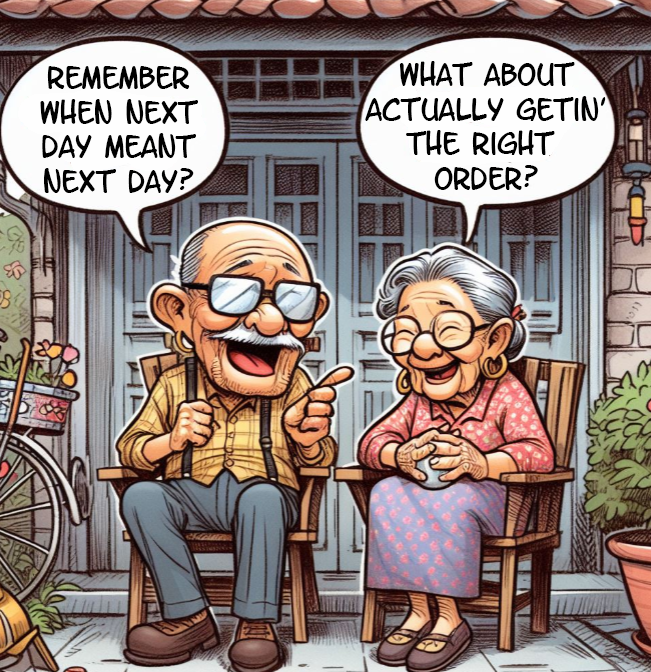
Two dinobabies are thinking about the good old days at Amazon. Thanks, MSFT Copilot. Your indigestion on February 9, 2024, appears to have worked itself out. How’s that security coming along? Heh heh heh.
In my opinion, the news hook for “The Junkification of Amazon: Why Does It Feel Like the Company Is Making Itself Worse?” is that Amazon needs to generate revenue, profits, and thrill pulses for stakeholders. I understand this idea. But there is a substantive point tucked into the write up. Here it is:
The view of Amazon from China is worth considering everywhere. Amazon lets Chinese manufacturers and merchants sell directly to customers overseas and provides an infrastructure for Prime shipping, which is rare and enormously valuable. It also has unilateral power to change its policies or fees and to revoke access to these markets in an instant
Amazon has found Chinese products a useful source of revenue. What I think is important is that Temu is an outfit focused on chopping away at Amazon’s vines around the throats of its buyers and sellers. My hunch is that Amazon is not able to regain the trust buyers and sellers once had in the company. The article focuses on “junkification.” I think there is a simpler explanation; to wit:
Amazon has fallen victim to decision craziness. Let me offer a few suggestions.
First, consider the Kindle. A person who reads licenses an ebook for a Kindle. The Kindle software displays:
- Advertisements which are intended to spark another purchase
- An interface which does not provide access to the specific ebooks stored on the device
- A baffling collection of buttons, options, and features related to bookmarks and passages a reader finds interesting. However, the tools are non-functional when someone like me reads content like the Complete Works of William James or keeps a copy of the ever-popular Harvard “shelf of books” on a Kindle.
For me, the Kindle is useless, so I have switched to reading ebooks on my Apple iPad. At least, I can figure out what’s on the device, what’s available from the Apple store, and where the book I am currently reading is located. However, Amazon has not been thinking about how to make really cheap Kindle more useful to people who still read books.
A second example is the wild and crazy collection of Amazon.com features. I attempted to purchase a pair of grey tactical pants. I found the fabric I wanted. I skipped the weird pop ups. I ignored the videos. And the reviews? Sorry. Sales spam. I located the size I needed. I ordered. The product would arrive two days after I ordered. Here’s what happened:
- The pants were marked 32 waist, 32 inseam, but the reality was a 28 inch waist and a 28 inch inseam. The fix? I ordered the pants directly from the US manufacturer and donated the pants to the Goodwill.
- Returns at Amazon are now a major hassle at least in Prospect, Kentucky.
- The order did not come in two days as promised. The teeny weensy pants came in five days. The norm? Incorrect delivery dates. Perfect for porch pirates, right?
A third example is one I have mentioned in this blog and in my lectures about online fraud. I ordered a CPU. Amazon shipped me a pair of red panties. Nope, neither my style nor a CPU. About 90 days after the rather sporty delivery, emails, and an article in this blog, Amazon refunded my $550. The company did not want me to return the red panties. I have them hanging on my server room’s Movin’ Cool air conditioner.
The New York Magazine article does not provide much about what’s gone wrong at Amazon. I think my examples make clear these management issues:
- Decisions are not customer centric. Money is more important that serving the customer which is a belabored point in numerous Jeff Bezos letters before he morphed into a Miami social magnet.
- The staff at Amazon have no clue about making changes that ensure a positive experience for buyers or sellers. Amazon makes decisions to meet goals, check off an item on a to do list, or expend the minimum amount of mental energy to provide a foundation for better decisions for buyers and sellers.
- Amazon’s management is unable to prevent decision rot in several, quite different businesses. The AWS service has Byzantine pricing and is struggling to remain competitive in the midst of AI craziness. The logistics business cannot meet delivery targets displayed to a customer when he or she purchases a product. The hardware business is making customers more annoyed than at any previous time. Don’t believe me? Just ask a Ring customer about the price increase or an Amazon Prime customer about advertising in Amazon videos. And Kindle users? It is obvious no one at Amazon pays much attention to Kindle users so why start now? The store front functions are from Bizarro World. I have had to write down on notecards where to find my credit card “points,” how to navigate directly to listings for used music CDs, where my licensed Amazon eBooks reside and once there what the sort options actually do, and what I need to do when a previously purchased product displays lawn mowers, not men’s white T shirts.
Net net: I appreciate the Doctorow-esque word “junkification.” That is close to what Amazon is doing: Converting products and services into junk. Does Amazon’s basement have a leak? Are those termites up there?
Stephen E Arnold, February 15, 2024
Estonia and e-Residency
November 21, 2022
I have been to Estonia a couple of time. Once I visited in the summer. Another time I visited in February. Here’s a tip: “Leaves of Grass” weather is preferable in my opinion.
I mention Estonia because I noted a link to the Estonian government’s e-Residency information. You can find the basics at “Become and E-Resident.”
The main idea is that one can join Estonia’s digital nation. E-Residency is open to people from other countries. The idea is that the business would be “location independent” and the company would be an EU outfit.
The benefits include:
- Grow your business remotely
- Minimized bureaucracy (keep in mind that this is an EU company within a Baltic state with a Russian border)
- Joining an international community.
There are nominal fees, probably less than US$200, and a background checking process.
The idea is an interesting one. However, the e-Residency does not appear to include one of those “golden passports” available from some countries.
Are there downsides? A few, for example:
- Explaining to a US tax authority what’s going on
- Anticipating how the program will evolve; for example, laws passed in Estonia going forward
- Dealing with litigation in the US, EU, and elsewhere
- Resolving issues arising from payment to vendors and collecting money from customers.
If this approach to business appears attractive, check out the Estonia government’s Web site.
Stephen E Arnold, November 21, 2022
TikTok eCommerce: Will It Work in the US?
November 18, 2022
Douyin, TikTok’s predecessor and home-nation counterpart, made a very fruitful decision to emphasize e-commerce in 2020. As owner ByteDance sought to export that success via TikTok, however, the effort has been less lucrative. In an effort to understand why, Rest of World‘s Rui Ma takes a step back and examines “How TikTok Became and e-Commerce Juggernaut in China.” One key factor was live stream shopping events, an arena Douyin dominates despite entering a year after rival Kuaishou and several years after e-commerce titan Alibaba. The interloper chose to focus on brands themselves and smaller sellers instead of major influencers whose audiences could evaporate with a single PR blunder. Ma considers:
“So how does Douyin actually make money from livestreaming e-commerce? If you guessed ‘by commission,’ you would only be half-correct, as the platform actually charges very little — typically 1%–5% of sales value, depending on the category of goods being sold. The take rate is low, partly because of the stiffly competitive environment, and partly because this helps boost turnover as more sellers are encouraged to use the platform. But in order to succeed, most of those sellers will have to pay Douyin in other ways, via different forms of advertising. Sound familiar? That’s right — much like how Amazon sellers pay to show up in top search results, Douyin allows you to advertise your live stream in users’ feeds. TikTok has just one option for creators to have paid posts (straightforwardly called ‘Promote’). But Douyin has at least two more, targeted towards boosting the live streams of business accounts. Together, these are believed to be a significant revenue stream for Douyin, and presumably, still part of the playbook TikTok hopes to bring overseas. Since Douyin requires live stream e-commerce transactions to be completed on the platform instead of being redirected elsewhere, this all forms a ‘closed loop,’ where the user never strays from the app. It’s the ideal flywheel, and the envy of platform companies everywhere.”
Then there is Douyin Partners, an imitation of Alibaba’s Taobao program. Third-party partners will set up and operate a seller’s account, from advertising strategy to storefront to logistics. We are told ByteDance has not yet tried to insert Partners into TikTok. Why did step one, the livestreaming e-commerce approach, fail in Europe and the US? We are not sure, but it does not look like ByteDance is ready to throw in the global aspiration towel just yet. Stay tuned.
Cynthia Murrell, November 18, 2022
TikTok and Adderall: A Combo of Interest
October 13, 2022
The pandemic has made it challenging to access healthcare in a timely fashion. Virtual visits can help—if done properly. That is why the Department of Health and Human Services began allowing providers to skip in-person evaluations before prescribing controlled substances. It was an emergency measure, but it is difficult to imagine ever stuffing that genie back in its bottle. Naturally, some entities have seized this opportunity to rake in profits at the expense of vulnerable, mostly younger, patients. Vox reports, “‘Scary Easy. Sketchy as Hell.’ How Startups Are Pushing Adderall on TikTok.” Reporter Sara Morrison writes:
“Due to a combination of the pandemic and the rise of telehealth startups, it’s never been easier to come across social media content that will convince you that you might have ADHD, or services that will prescribe meds for it if they determine that you do. But that content isn’t always coming from health care professionals. Much of the TikTok content can be considered inaccurate or misleading. Meanwhile, it’s especially important that ADHD assessments are careful and thorough so that health care professionals can rule out other conditions with the same or similar symptoms as ADHD, look for coexisting conditions, and screen for people who are seeking ADHD meds like Adderall to abuse. Diagnosing someone with a condition they don’t have — and prescribing meds to treat it — means they aren’t getting diagnosed and treated for whatever condition or conditions they do have. And ADHD meds aren’t effective when taken by people who don’t have ADHD, but they can be addictive and abused. … Between the beginning of 2020 and the end of 2021, prescriptions for Adderall and its generic equivalents increased by nearly 25 percent during the pandemic for the 22-44 age group, a trend that health care analytics firm Trilliant Health attributed to ‘the emergence of digital mental health platforms.'”
Accurate diagnoses can be made online, but only if providers dedicate ample time to each assessment—preferable about two hours. These TikTok opportunists allot much less time. The aptly named Done, for example, offers 30-minute assessments with 15-minute follow-ups. Even some of the patients, though eager for a solution, report feeling rushed. Public scrutiny does seem to have curbed the trend somewhat. But Morrison notes Done, for one, is not slowing down its prescription gravy train. See the write-up for more details, but basically Done has partnered with several influencers to push its brand and, it seems, convince TikTok users they need its services. Then, of course, the platform’s algorithm feeds more and more of this content, much of it inaccurate, to users who express any interest in ADHD.
In general, telehealth can be a real boon for those who need healthcare during this time of chronic staff shortages. Too bad some shady companies are seizing this moment profit at all costs.
Cynthia Murrell, October 13, 2022
TikTok E-Commerce a Success—In China, That Is
October 11, 2022
Douyin, TikTok’s predecessor and home-nation counterpart, made a very fruitful decision to emphasize e-commerce in 2020. As owner ByteDance sought to export that success via TikTok, however, the effort has been less lucrative. In an effort to understand why, Rest of World‘s Rui Ma takes a step back and examines “How TikTok Became and e-Commerce Juggernaut in China.” One key factor was live stream shopping events, an arena Douyin dominates despite entering a year after rival Kuaishou and several years after e-commerce titan Alibaba. The interloper chose to focus on brands themselves and smaller sellers instead of major influencers whose audiences could evaporate with a single PR blunder. Ma considers:
“So how does Douyin actually make money from live streaming e-commerce? If you guessed ‘by commission,’ you would only be half-correct, as the platform actually charges very little — typically 1%–5% of sales value, depending on the category of goods being sold. The take rate is low, partly because of the stiffly competitive environment, and partly because this helps boost turnover as more sellers are encouraged to use the platform. But in order to succeed, most of those sellers will have to pay Douyin in other ways, via different forms of advertising. Sound familiar? That’s right — much like how Amazon sellers pay to show up in top search results, Douyin allows you to advertise your live stream in users’ feeds. TikTok has just one option for creators to have paid posts (straightforwardly called ‘Promote’). But Douyin has at least two more, targeted towards boosting the live streams of business accounts. Together, these are believed to be a significant revenue stream for Douyin, and presumably, still part of the playbook TikTok hopes to bring overseas. Since Douyin requires live stream e-commerce transactions to be completed on the platform instead of being redirected elsewhere, this all forms a ‘closed loop,’ where the user never strays from the app. It’s the ideal flywheel, and the envy of platform companies everywhere.”
Then there is Douyin Partners, an imitation of Alibaba’s Taobao program. Third-party partners will set up and operate a seller’s account, from advertising strategy to storefront to logistics. We are told ByteDance has not yet tried to insert Partners into TikTok. Why did step one, the live streaming e-commerce approach, fail in Europe and the US? We are not sure, but it does not look like ByteDance is ready to throw in the global aspiration towel just yet. Stay tuned.
Cynthia Murrell, October 11, 2022
Amazon: Is the Company Losing Control of Essentials?
April 11, 2022
Here’s a test question? Which is the computer product in the image below?
|
[a] |
[b] |
 |
 |
If you picked [a], you qualify for work at TopCharm, an Amazon service located in lovely Brooklyn at 3912 New Utrecht Avenue, zip 11219. Item [b] is the Ryzen cpu I ordered, paid for, and expected to arrive. TopCharm delivered: Panties, not the CPU. Is it easy to confuse a Ryzen 5900X with these really big, lacy, red “unmentionables”? One of my team asked me, “Do you want me to connect the red lace cpu to the ASUS motherboard?”
Ho ho ho.
What does Clustrmaps.com say about this location””?
This address has been used for business registration by Express Repair & Towing Inc. The property belongs to Lelah Inc. [Maybe these are Lelah’s underwear? And Express Repair & Towing? Yep, that sounds like a vendor of digital panties, red and see-through at that.]
One of my team suggested I wear the garment for my lecture in April 2021 at the National Cyber Crime Conference? My wife wanted to know if Don (one of my technical team) likes red panties? A neighbor’s college-attending son asked, “Who is the babe who wears that? Can I have her contact info?”
My sense of humor about this matter is officially exhausted.
Several observations about this Amazon transaction:
- Does the phrase “too big to manage” apply in this situation to Amazon’s ecommerce business?
- What type of stocking clerk confuses a high end CPU with cheap red underwear?
- What quality assurance methods are in place to protect a consumer from cheap jokes and embarrassment when this type of misstep occurs?
Has Amazon lost control of the basics of online commerce? If one confuses CPUs with panties, how is Amazon going to ensure that its Government Cloud services for the public sector stay online? Quite a misstep in my opinion. Is this cyber fraud, an example of management lapses, a screwed up inventory system, or a perverse sense of humor?
Stephen E Arnold, April 11, 2022
TikTok and the Ecommerce Revolution
July 6, 2021
Online shopping is going through a major shakeup, and China is the epicenter. Verdict declares, “Watch Out Amazon, TikTok Is Coming for You with Short-Video Ecommerce.” Writer Elles Houweling introduces us to “618” (June 18th), an annual Chinese cybershopping festival that combines advertising with entertainment. Alongside traditional tactics like exclusive offers and discounts, retailers compete for attention with interactive live streaming events and the participation of internet influencers. Transactions can be made right on the social platforms that engage customers, smoothing the path to profits. Such developments may be no surprise from the nation that has the highest rate of ecommerce, according to research firm GlobalData. Houweling writes:
“Something that may come as news, however, is the speed at which short-video apps and live streaming ecommerce are taking over. Relatively new to the 618 game are social media platforms Douyin (China’s version of TikTok) and similar apps Kuaishou and Xiaohongshu, which are rapidly making their mark in the world of ecommerce. These apps have achieved something that traditional online retailers have long neglected: seamlessly merging shopping with entertainment. Chinese netizens are increasingly turning to social media platforms to make purchases. In the West, TikTok is not yet widely associated with the idea of ecommerce, but this may soon change. Recently, TikTok announced that it had entered into partnerships with several companies, including Wal-Mart, Shopify and L’Oréal, to bring the app’s ecommerce platform to a Western audience. We may soon find a cohort of Millennials and GenZs not only learning their latest dance moves from TikTok but also buying their daily products, a trend that may threaten well-established ecommerce behemoths such as Amazon. Moreover, social media platforms have introduced new forms of cybershopping. Soon short-video advertisements and live broadcasts may replace the traditional search and click model of online retail.”
TikTok is now testing in-app sales features in Europe. Wal-Mart just partnered with TikTok on live-stream shopping, a move GlobalData sees as a real threat to Amazon. Though that company now has Amazon Live, the feature seems unlikely to capture nearly as much attention as TikTok will command on Wal-Mart’s behalf. The article notes one of TikTok’s strengths is its recommendation algorithm, which factors in what users do not like as well as what they do. The AI’s uncanny knack for discerning preferences makes for a strong marketing advantage. Perhaps that was the plan all along?
Didn’t some hyperactive rich person call this method ACommerce? The A does not mean what you think it means. The A is for algorithmic. I think.
Cynthia Murrell, June 30, 2021
A Useful but Brief Taxonomy of Dark Patterns
December 29, 2020
The idea that one can lead a hapless Web surfer by the nose has been fascinating to me for years. The idea is that one tries to purchase something online; for example, a downloadable Photoshop macro or buy a package of batteries on a deal site. Then the system pops up requests for information or displays “Other customers liked” messages. The person who follows these digital breadcrumbs discovers that a surprise has been delivered. The single macro is a bundle and the batteries include an flashlight.
“Types of Dark Patterns” provides a handy list of the specific methods for getting that nose going in the direction it may not have wanted to go. The write up includes 12 types of dark patterns. I am not confident that the list is exhaustive, but it is a good start. Here are three dark patterns briefly explained in the article, and be sure to consult the original write up for the complete list:
- Privacy Zuckering. This pattern is named in honor of that estimable innovator Mark Zuckerberg.
- Hidden costs. A popular method for some eBay sellers and a vendor who sells big bars of soap.
- Forced continuity. The name could be better but the idea is that a single purchase leads to monthly charges because you subscribed to something. Perhaps it is a good idea to check PayPal to see if a merchant has been billing a modest amount each month even though you purchased a single service on Fiverr, the Israel-based gig site.
There’s nothing like cleverness combined with duplicity in the wild, wonderful world of online.
Stephen E Arnold, December 29, 2020
Shopify: Going with the Flow
December 22, 2020
I read “Thousands of Fraudsters Are Selling via Shopify, Analysis Finds.” I know Shopify has been a must mention platform by one of the New Age broadcast stars, or I think it is podcast stars now. Other than that hype hose, I know zero about the company. In the write up, I spotted an interesting factoid. If the datum is accurate, I have learned a great deal about the governance of the firm and its ethical compass. Herewith is the allegedly accurate factoid:
According to the ecommerce authentication service FakeSpot, which analyzed more than 120,000 Shopify sites, as many as 21 per cent posed a risk to shoppers.
Yowza.
Stephen E Arnold, December 22, 2020
Google Shopping and Relevance. Ho, Ho, Ho
July 28, 2020
DarkCyber tested Google Shopping. The query was golf shirts for men –Amazon. Here is page 9 of the result:

Some observations. Four of the seven shirts were for products intended for females. One of the products was for a jacket. The other products were for bulk orders of golf shirts.
About that relevance algorithm? Ho, ho, ho.
Stephen E Arnold, July 28, 2020
-

- Subscribe to Beyond Search
Feature archive
News archive

-


