

Google and Third-Party Cookies: The Writing Is on the Financial Projection Worksheet
July 25, 2024
 This essay is the work of a dumb dinobaby. No smart software required.
I have been amused by some of the write ups about Google’s third-party cookie matter. Google is the king of the jungle when it comes to saying one thing and doing another. Let’s put some wood behind social media. Let’s make that Dodgeball thing take off. Let’s make that AI-enhanced search deliver more user joy. Now we are in third-party cookie revisionism. Even Famous Amos has gone back to its “original” recipe after the new and improved Famous Amos chips tanked big time. Google does not want to wait to watch ad and data sale-related revenue fall. The Google is changing its formulation before the numbers arrive.
“Google No Longer Plans to Eliminate Third-Party Cookies in Chrome” explains:
Google announced its cookie updates in a blog post shared today, where the company said that it instead plans to focus on user choice.
What percentage of Google users alter default choices? Don’t bother to guess. The number is very, very few. The one-click away baloney is a fabrication, an obfuscation. I have technical support which makes our systems as secure as possible given the resources an 80-year-old dinobaby has. But check out those in the rest home / warehouse for the soon to die? I would wager one US dollar that absolutely zero individuals will opt out of third-party cookies. Most of those in Happy Trail Ending Elder Care Facility cannot eat cookies. Opting out? Give me a break.

The MacRumors’ write up continues:
Back in 2020, Google claimed that it would phase out support for third-party cookies in Chrome by 2022, a timeline that was pushed back multiple times due to complaints from advertisers and regulatory issues. Google has been working on a Privacy Sandbox to find ways to improve privacy while still delivering info to advertisers, but third-party cookies will now be sticking around so as not to impact publishers and advertisers.
The Apple-centric online publication notes that UK regulators will check out Google’s posture. Believe me, Googzilla sits up straight when advertising revenue is projected to tank. Losing click data which can be relicensed, repurposed, and re-whatever is not something the competitive beastie enjoys.
MacRumors is not anti-Google. Hey, Google pays Apple big bucks to be “there” despite Safari. Here’s the online publications moment of hope:
Google does not plan to stop working on its Privacy Sandbox APIs, and the company says they will improve over time so that developers will have a privacy preserving alternative to cookies. Additional privacy controls, such as IP Protection, will be added to Chrome’s Incognito mode.
Correct. Google does not plan. Google outputs based on current situational awareness. That’s why Google 2020 has zero impact on Google 2024.
Three observations which will pain some folks:
- Google AI search and other services are under a microscope. I find the decision one which may increase scrutiny, not decrease regulators’ interest in the Google. Google made a decision which generates revenue but may increase legal expenses
- No matter how much money swizzles at each quarter’s end, Google’s business model may be more brittle than the revenue and profit figures suggest. Google is pumping billions into self driving cars, and doing an about face on third party cookies? The new Google puzzles me because search seems to be in the background.
- Google’s management is delivering revenues and profit, so the wizardly leaders are not going anywhere like some of Google’s AI initiatives.
Net net: After 25 years, the Google still baffles me. Time to head for Philz Coffee.
Stephen E Arnold, July 25, 2024
Google AdWords in Russia?
July 23, 2024
 This essay is the work of a dumb humanoid. No smart software required.
I have been working on a project requiring me to examine a handful of Web sites hosted in Russia, in the Russian language, and tailored for people residing in Russia and its affiliated countries. I came away today with a screenshot from the site for IT Cube Studio. The outfit creates Web sites and provides advertising services. Here’s a screenshot in Russian which advertises the firm’s ability to place Google AdWords for a Russian client:

If you don’t read Russian, here’s the translation of the text. I used Google Translate which seems to do an okay job with the language pair Russian to English. The ad says:
Contextual advertising. Potential customers and buyers on your website a week after the start of work.
The word

is the Russian spelling of Yandex. The Google word is “Google.”
I thought there were sanctions. In fact, I navigated to Google and entered this query “google AdWords Russia.” What did Google tell me on July 22, 2024, 503 pm US Eastern time?
Here’s the Google results page:
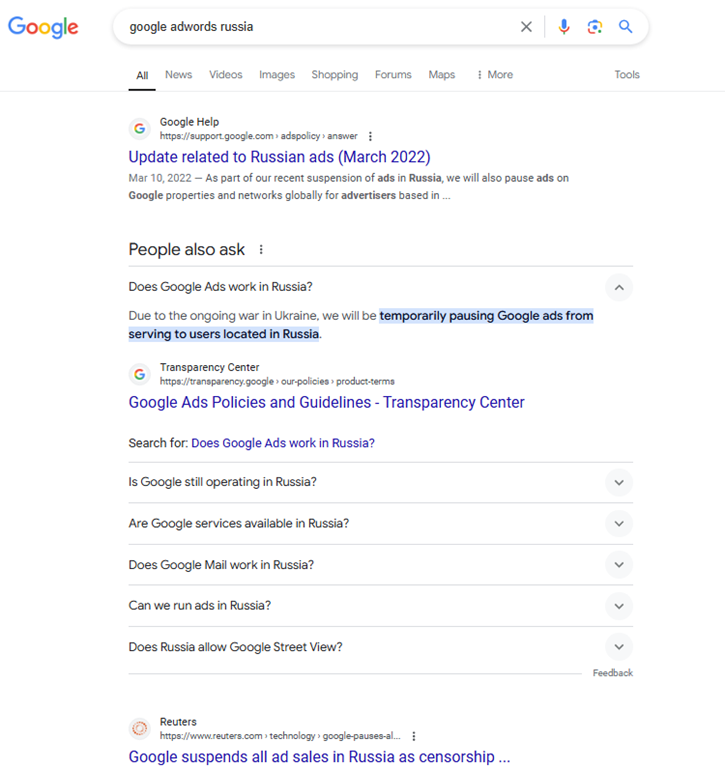
The screenshot is difficult to read, but let me highlight the answer to my question about Google’s selling AdWords in Russia.
There is a March 10, 2022, update which says:
Mar 10, 2022 — As part of our recent suspension of ads in Russia, we will also pause ads on Google properties and networks globally for advertisers based in [Russia] …
Plus there is one of those “smart” answers which says:
People also ask
Does Google Ads work in Russia?
Due to the ongoing war in Ukraine, we will be temporarily pausing Google ads from serving to users located in Russia. [Emphasis in the original Google results page display}
I know my Russian is terrible, but I am probably slightly better equipped to read and understand English. The Google results seem to say, “Hey, we don’t sell AdWords in Russia.”
I wonder if the company IT Cube Studio is just doing some marketing razzle dazzle. Is it possible that Google is saying one thing and doing another in Russia? I recall that Google said it wasn’t WiFi sniffing in Germany a number of years ago. I believe that Google was surprised when the WiFi sniffing was documented and disclosed.
I find these big company questions difficult to answer. I am certainly not a Google-grade intellect. I am a dinobaby. And I am inclined to believe that there is a really simple explanation or a very, very sincere apology if the IT Cube Studio outfit is selling Google AdWords when sanctions are in place.
If anyone of the two or three people who follow my Web log knows the answer to my questions, please, let me know. You can write me at benkent2020 at yahoo dot com. For now, I find this interesting. The Google would not violate sanctions, would it?
Stephen E Arnold, July 23, 2024
Looking for the Next Big Thing? The Truth Revealed
July 18, 2024
![dinosaur30a_thumb_thumb_thumb_thumb_[1]](https://arnoldit.com/wordpress/wp-content/uploads/2024/07/dinosaur30a_thumb_thumb_thumb_thumb_1.gif "dinosaur30a_thumb_thumb_thumb_thumb_[1]") This essay is the work of a dinobaby. Unlike some folks, no smart software improved my native ineptness.
This essay is the work of a dinobaby. Unlike some folks, no smart software improved my native ineptness.
Big means money, big money. I read “Twenty Five Years of Warehouse-Scale Computing,” authored by Googlers who definitely are into “big.” The write up is history from the point of view of engineers who built a giant online advertising and surveillance system. In today’s world, when a data topic is raised, it is big data. Everything is Texas-sized. Big is good.
This write up is a quasi-scholarly, scientific-type of sales pitch for the wonders of the Google. That’s okay. It is a literary form comparable to an epic poem or a jazzy H.L. Menken essay when people read magazines and newspapers. Let’s take a quick look at the main point of the article and then consider its implications.
I think this passage captures the zeitgeist of the Google on July 13, 2024:
From a team-culture point of view, over twenty five years of WSC design, we have learnt a few important lessons. One of them is that it is far more important to focus on “what does it mean to land” a new product or technology; after all, it was the Apollo 11 landing, not the launch, that mattered. Product launches are well understood by teams, and it’s easy to celebrate them. But a launch doesn’t by itself create success. However, landings aren’t always self-evident and require explicit definitions of success — happier users, delighted customers and partners, more efficient and robust systems – and may take longer to converge. While picking such landing metrics may not be easy, forcing that decision to be made early is essential to success; the landing is the “why” of the project.

A proud infrastructure plumber knows that his innovations allows the home owner to collect rent from AirBnB rentals. Thanks, MSFT Copilot. Interesting image because I did not specify gender or ethnicity. Does my plumber look like this? Nope.
The 13 page paper includes numerous statements which may resonate with different readers as more important. But I like this passage because it makes the point about Google’s failures. There is no reference to smart software, but for me it is tough to read any Google prose and not think in terms of Code Red, the crazy flops of Google’s AI implementations, and the protestations of Googlers about quantum supremacy or some other projection of inner insecurity the company’s genius concoct. Don’t you want to have an implant that makes Google’s knowledge of “facts” part of your being? America’s founding fathers were not diverse, but Google has different ideas about reality.
This passage directly addresses failure. A failure is a prelude to a soft landing or a perfect landing. The only problem with this mindset is that Google has managed one perfect landing: Its derivative online advertising business. The chatter about scale is a camouflage tarp pulled over the mad scramble to find a way to allow advertisers to pay Google money. The “invention” was forced upon those at Google who wanted those ad dollars. The engineers did many things to keep the money flowing. The “landing” is the fact that the regulators turned a blind eye to Google’s business practices and the wild and crazy engineering “fixes” worked well enough to allow more “fixes.” Somehow the mad scramble in the 25 years of “history” continues to work.
Until it doesn’t.
The case in point is Google’s response to the Microsoft OpenAI marketing play. Google’s ability to scale has not delivered. What delivers at Google is ad sales. The “scale” capabilities work quite well for advertising. How does the scale work for AI? Based on the results I have observed, the AI pullbacks suggest some issues exist.
What’s this mean? Scale and the cloud do not solve every problem or provide a slam dunk solution to a new challenge.
The write up offers a different view:
On one hand, computing demand is poised to explode, driven by growth in cloud computing and AI. On the other hand, technology scaling slowdown poses continued challenges to scale costs and energy-efficiency
Google sees that running out of chip innovations, power, cooling, and other parts of the scale story are an opportunity. Sure they are. Google’s future looks bright. Advertising has been and will be a good business. The scale thing? Plumbing. Let’s not forget what matters at Google. Selling ads and renting infrastructure to people who no longer have on-site computing resources. Google is hoping to be the AirBnB of computation. And sell ads on Tubi and other ad-supported streaming services.
Stephen E Arnold, July 18, 2024
Google Ups the Ante: Skip the Quantum. Aim Higher!
July 16, 2024
 This essay is the work of a dinobaby. Unlike some folks, no smart software improved my native ineptness.
After losing its quantum supremacy crown to an outfit with lots of “u”s in its name and making clear it deploys a million software bots to do AI things, the Google PR machine continues to grind away.

The glowing “G” on god’s/God’s chest is the clue that reveals Google’s identity. Does that sound correct? Thanks, MSFT Copilot. Close enough to the Google for me.
What’s a bigger deal than quantum supremacy or the million AI bot assertion? Answer: Be like god or God as the case may be. I learned about this celestial achievement in “Google Researchers Say They Simulated the Emergence of Life.” The researchers have not actually created life. PR announcements can be sufficiently abstract to make a big Game of Life seem like more than an update of the 1970s John Horton Conway confection on a two-dimensional grid. Google’s goal is to get a mention in the Wikipedia article perhaps?
Google operates at a different scale in its PR world. Google does not fool around with black and white squares, blinkers, and spaceships. Google makes a simulation of life. Here’s how the write up explains the breakthrough:
In an experiment that simulated what would happen if you left a bunch of random data alone for millions of generations, Google researchers say they witnessed the emergence of self-replicating digital lifeforms.
Cue the pipe organ. Play Toccata and Fugue in D minor. The write up says:
Laurie and his team’s simulation is a digital primordial soup of sorts. No rules were imposed, and no impetus was given to the random data. To keep things as lean as possible, they used a funky programming language called Brainfuck, which to use the researchers’ words is known for its “obscure minimalism,” allowing for only two mathematical operations: adding one or subtracting one. The long and short of it is that they modified it to only allow the random data — stand-ins for molecules — to interact with each other, “left to execute code and overwrite themselves and neighbors based on their own instructions.” And despite these austere conditions, self-replicating programs were able to form.
Okay, tone down the volume on the organ, please.
The big discovery is, according to a statement in the write up attributed to a real life God-ler:
there are “inherent mechanisms” that allow life to form.
The God-ler did not claim the title of God-ler. Plus some point out that Google’s big announcement is not life. (No kidding?)
Several observations:
- Okay, sucking up power and computer resources to run a 1970s game suggests that some folks have a fairly unstructured work experience. May I suggest a bit of work on Google Maps and its usability?
- Google’s PR machine appears to value quantumly supreme reports of innovations, break throughs, and towering technical competence. Okay, but Google sells advertising, and the PR output doesn’t change that fact. Google sells ads. Period.
- The speed with which Google PR can react to any perceived achievement that is better or bigger than a Google achievement pushes the Emit PR button. Who punches this button?
Net net: I find these discoveries and innovations amusing. Yeah, Google is an ad outfit and probably should be headquartered on Madison Avenue or an even more prestigious location. Definitely away from Beelzebub and his ilk.
Stephen E Arnold, July 16, 2024
The Wiz: Google Gears Up for Enterprise Security
July 15, 2024
 This essay is the work of a dinobaby. Unlike some folks, no smart software improved my native ineptness.
Anyone remember this verse from “Ease on Down the Road,” from The Wiz, the hit musical from the 1970s? Here’s the passage:
‘Cause there may be times
When you think you lost your mind
And the steps you’re takin’
Leave you three, four steps behind
But the road you’re walking
Might be long sometimes
You just keep on trukin’
And you’ll just be fine, yeah
Why am I playing catchy tunes in my head on Monday, July 15, 2024? I just read “Google Near $23 Billion Deal for Cybersecurity Startup Wiz.” For years, I have been relating Israeli-developed cyber security technology to law enforcement and intelligence professionals. I try in each lecture to profile a firm, typically based in Tel Aviv or environs and staffed with former military professionals. I try to relate the functionality of the system to the particular case or matter I am discussing in my lecture.
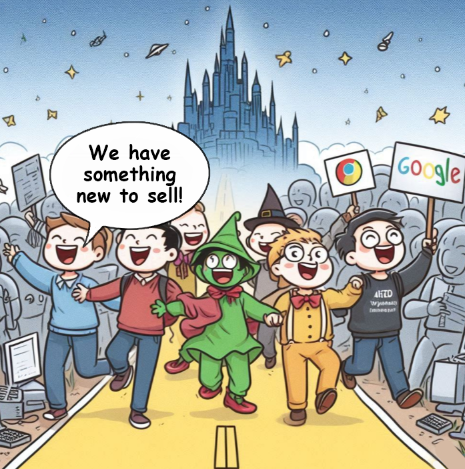
The happy band is easin’ down the road. The Googlers have something new to sell. Does it work? Sure, get down. Boogie. Thanks, MSFT Copilot. Has your security created an opportunity for Google marketers?
That stopped in October 2023. A former Israeli intelligence officer told me, “The massacre was Israel’s 9/11. There was an intelligence failure.” I backed away form the Israeli security, cyber crime, and intelware systems. They did not work. If we flash forward to July 15, 2024, the marketing is back. The well-known NSO Group is hawking its technology at high-profile LE and intel conferences. Enhancements to existing systems arrive in the form of email newsletters at the pace of the pre-October 2023 missives.
However, I am maintaining a neutral and skeptical stance. There is the October 2023 event, the subsequent war, and the increasing agitation about tactics, weapons systems in use, and efficacy of digital safeguards.
Google does not share my concerns. That’s why the company is Google, and I am a dinobaby tracking cyber security from my small office in rural Kentucky. Google makes news. I make nothing as a marginalized dinobaby.
The Wiz tells the story of a young girl who wants to get her dog back after a storm carries the creature away. The young girl offs the evil witch and seeks the help of a comedian from Peoria, Illinois, to get back to her real life. The Wiz has a happy ending, and the quoted verse makes the point that the young girl, like the Google, has to keep taking steps even though the Information Highway may be long.
That’s what Google is doing. The company is buying security (which I want to point out is cut from the same cloth as the systems which failed to notice the October 2023 run up). Google has Mandiant. Google offers a free Dark Web scanning service. Now Google has Wiz.
What’s Wiz do? Like other Israeli security companies, it does the sort of thing intended to prevent events like October 2023’s attack. And like other aggressively marketed Israeli cyber technology companies’ capabilities, one has to ask, “Will Wiz work in an emerging and fluid threat environment?” This is an important question because of the failure of the in situ Israeli cyber security systems, disabled watch stations, and general blindness to social media signals about the October 2023 incident.
If one zips through the Wiz’s Web site, one can craft a description of what the firm purports to do; for example:
Wiz is a cloud security firm embodying capabilities associated with the Israeli military technology. The idea is to create a one-stop shop to secure cloud assets. The idea is to identify and mitigate risks. The system incorporates automated functions and graphic outputs. The company asserts that it can secure models used for smart software and enforce security policies automatically.
Does it work? I will leave that up to you and the bad actors who find novel methods to work around big, modern, automated security systems. Did you know that human error and old-fashioned methods like emails with links that deliver stealers work?
Can Google make the Mandiant Wiz combination work magic? Is Googzilla a modern day Wiz able to transport the little girl back to real life?
Google has paid a rumored $20 billion plus to deliver this reality.
I maintain my neutral and skeptical stance. I keep thinking about October 2023, the aftermath of a massive security failure, and the over-the-top presentations by Israeli cyber security vendors. If the stuff worked, why did October 2023 happen? Like most modern cyber security solutions, marketing to the people who desperately want a silver bullet or digital stake to pound through the heart of cyber risk produces sales.
I am not sure that sales, marketing, and assertions about automation work in what is an inherently insecure, fast-changing, and globally vulnerable environment.
But Google will keep on trukin’’ because Microsoft has created a heck of a marketing opportunity for the Google.
Stephen E Arnold, July 15, 2024
Google: Another Unfair Allegation and You Are Probably Sorry
July 10, 2024
Just as some thought Google was finally playing nice with content rightsholders, a group of textbook publishers begs to differ—in court. TorrentFreak reports, “Google ‘Profits from Pirated Textbooks’ Publishers’ Lawsuit Claims.” The claimants accuse Google of not only ignoring textbook pirates in search results, but of actively promoting them to line its own coffers. Writer Andy Maxwell quotes the complaint:
“’Of course, Google’s Shopping Ads for Infringing Works … do not use photos of the pirates’ products; rather, they use unauthorized photos of the Publishers’ own textbooks, many of which display the Marks. Thus, with Infringing Shopping Ads, this “strong sense of the product” that Google is giving is a bait-and-switch,’ the complaint alleges.”
The complaint emphasizes Google actively creates, ranks, and targets ads for pirated products. It also assesses the quality of advertised sites. It is fishy, then, that infringing works often rank before or near ads for the originals.
In case one is still willing to give Google the benefit of the doubt, the complaint lists several reasons the company should know better. There are the sketchy site names like “Cheapbok,” and “Biz Ninjas.” Then there are the unrealistically low prices. A semester’s worth of textbooks should break the bank; that is just part of the college experience. Perhaps even more damning is Google’s own assertion it verifies sellers’ identities. The write-up continues:
“[The publishers] claim that verification means Google has the ability to communicate with sellers via email or verified phone numbers. In cases where Google was advised that a seller was offering pirated content and Google users were still able to place orders after clicking an ad, ‘Google had the ability to stop the direct infringement entirely.’ In the majority of cases where pirate sellers predominantly or exclusively use Google Ads to reach their customer base, terminating their accounts would’ve had a significant impact on future sales.”
No doubt. Publishers have tried to address the issue through Google’s stated process of takedown notices to no avail. In fact, they allege, the company is downright hostile to any that push the issue. We learn:
“When the publishers sent follow-up notices for matters previously reported but not handled to their satisfaction, ‘Google threatened on multiple occasions to stop reviewing all the Publishers’ notices for up to six months,’ the complaint alleges. Google’s response was due to duplicate requests; the company warned that if that happened three or more times on the same request, it would ‘consider that particular request to be manifestly unfounded’ which could lead the company to ‘temporarily stop reviewing your requests for a period of up to 180 days.’”
Ah, corporate logic. Will Google’s pirate booty be worth the legal headaches? The textbook publishers bringing suit include Cengage Learning, Macmillan Learning, Macmillan Holdings, LLC; Elsevier Inc., Elsevier B.V., and McGraw Hill LLC. The complaint was filed in the US District Court for the Southern District of New York.
Cynthia Murrell, July 10, 2024
Does Google Have a Monopoly? Does AI Search Make a Difference?
July 9, 2024
I read “2024 Zero-Click Search Study: For Every 1,000 EU Google Searches, Only 374 Clicks Go to the Open Web. In the US, It’s 360.” The write up begins with caveats — many caveats. But I think I am not into the search engine optimization and online advertising mindset. As a dinobaby, I find the pursuit of clicks in a game controlled by one outfit of little interest.

Is it possible that what looks like a nice family vacation place is a digital roach motel? Of course not! Thanks, MSFT Copilot. Good enough.
Let’s answer the two questions the information in the report from the admirably named SparkToro presents. In my take on the article, the charts, the buzzy jargon, the answer to the question, “Does Google Have a Monopoly?” the answer is, “Wow, do they.”
The second question I posed is, “Does AI Search Make a Difference in Google Traffic?’ the answer is, “A snowball’s chance in hell is better.”
The report and analysis takes me to close enough for horse shoes factoids. But that’s okay because the lack of detailed, reliable data is part of the way online operates. No one really knows if the clicks from a mobile device are generated by a nepo baby with money to burn or a bank of 1,000 mobile devices mindlessly clicking on Web destinations. Factoids about online activity are, at best, fuzzy. I think SEO experts should wear T shirts and hats with this slogan, “Heisenberg rocks. I am uncertain.
I urge you to read and study the SparkToro analysis. (I love that name. An electric bull!)
The article points out that Google gets a lot of clicks. Here’s a passage which knits together several facts from the study:
Google gets 1/3 of the clicks. Imagine a burger joint selling 33 percent of the burgers worldwide. Could they get more? Yep. How much more:
Equally concerning, especially for those worried about Google’s monopoly power to self-preference their own properties in the results, is that almost 30% of all clicks go to platforms Google owns. YouTube, Google Images, Google Maps, Google Flights, Google Hotels, the Google App Store, and dozens more means that Google gets even more monetization and sector-dominating power from their search engine. Most interesting to web publishers, entrepreneurs, creators, and (hopefully) regulators is the final number: for every 1,000 searches on Google in the United States, 360 clicks make it to a non-Google-owned, non-Google-ad-paying property. Nearly 2/3rds of all searches stay inside the Google ecosystem after making a query.
The write up also presents information which suggests that the European Union’s regulations don’t make much difference in the click flow. Sorry, EU. You need another approach, perhaps?
In the US, users of Google have a tough time escaping what might be colorfully named the “digital roach motel.”
Search behavior in both regions is quite similar with the exception of paid ads (EU mobile searchers are almost 50% more likely to click a Google paid search ad) and clicks to Google properties (where US searchers are considerably more likely to find themselves back in Google’s ecosystem after a query).
The write up presented by SparkToro (Is it like the energizer bunny?) answers a question many investors and venture firms with stakes in smart software are asking: “Is Google losing search traffic? The answer is, “Nope. Not a chance.”
According to Datos’ panel, Google’s in no risk of losing market share, total searches, or searches per searcher. On all of these metrics they are, in fact, stronger than ever. In both the US and EU, searches per searcher are rising and, in the Spring of 2024, were at historic highs. That data doesn’t fit well with the narrative that Google’s cost themselves credibility or that Internet users are giving up on Google and seeking out alternatives. … Google continues to send less and less of its ever-growing search pie to the open web…. After a decline in 2022 and early 2023, Google’s back to referring a historically high amount of its search clicks to its own properties.
AI search has not been the game changer for which some hoped.
Net net: I find it interesting that data about what appears to be a monopoly is so darned sketchy after more than two decades of operation. For Web search start ups, it may be time to rethink some of those assertions in those PowerPoint decks.
Stephen E Arnold, July 9, 2024
The AI Revealed: Look Inside That Kimono and Behind It. Eeew!
July 9, 2024
 This essay is the work of a dumb dinobaby. No smart software required.
The Guardian article “AI scientist Ray Kurzweil: ‘We Are Going to Expand Intelligence a Millionfold by 2045’” is quite interesting for what it does not do: Flip the projection output by a Googler hired by Larry Page himself in 2012.

Putting toothpaste back in a tube is easier than dealing with the uneven consequences of new technology. What if rosy descriptions of the future are just marketing and making darned sure the top one percent remain in the top one percent? Thanks Chat GPT4o. Good enough illustration.
First, a bit of math. Humans have been doing big tech for centuries. And where are we? We are post-Covid. We have homelessness. We have numerous armed conflicts. We have income inequality in the US and a few other countries I have visited. We have a handful of big tech companies in the AI game which want to be God to use Mark Zuckerberg’s quaint observation. We have processed food. We have TikTok. We have systems which delight and entertain each day because of bad actors’ malware, wild and crazy education, and hybrid work with the fascinating phenomenon of coffee badging; that is, going to the office, getting a coffee, and then heading to the gym.
Second, the distance in earth years between 2024 and 2045 is 21 years. In the humanoid world, a 20 year old today will be 41 when the prediction arrives. Is that a long time? Not for me. I am 80, and I hope I am out of here by then.
Third, let’s look at the assertions in the write up.
One of the notable statements in my opinion is this one:
I’m really the only person that predicted the tremendous AI interest that we’re seeing today. In 1999 people thought that would take a century or more. I said 30 years and look what we have.
I like the quality of modesty and humblebrag. Googlers excel at both.
Another statement I circled is:
The Singularity, which is a metaphor borrowed from physics, will occur when we merge our brain with the cloud. We’re going to be a combination of our natural intelligence and our cybernetic intelligence and it’s all going to be rolled into one.
I like the idea that the energy consumption required to deliver this merging will be cheap and plentiful. Googlers do not worry about a power failure, the collapse of a dam due to the ministrations of the US Army Corps of Engineers and time, or dealing with the environmental consequences of producing and moving energy from Point A to Point B. If Google doesn’t worry, I don’t.
Here’s a quote from the article allegedly made by Mr. Singularity aka Ray Kurzweil:
I’ve been involved with trying to find the best way to move forward and I helped to develop the Asilomar AI Principles [a 2017 non-legally binding set of guidelines for responsible AI development]. We do have to be aware of the potential here and monitor what AI is doing.
I wonder if the Asilomar AI Principles are embedded in Google’s system recommending that one way to limit cheese on a pizza from sliding from the pizza to an undesirable location embraces these principles? Is the dispute between the “go fast” AI crowd and the “go slow” group not aware of the Asilomar AI Principles. If they are, perhaps the Principles are balderdash? Just asking, of course.
Okay, I think these points are sufficient for going back to my statements about processed food, wars, big companies in the AI game wanting to be “god” et al.
The trajectory of technology in the computer age has been a mixed bag of benefits and liabilities. In the next 21 years, will this report card with some As, some Bs, lots of Cs, some Ds, and the inevitable Fs be different? My view is that the winners with human expertise and the know how to make money will benefit. I think that the other humanoids may be in for a world of hurt. That’s the homelessness stuff, the being dumb when it comes to doing things like reading, writing, and arithmetic, and consuming chemicals or other “stuff” that parks the brain will persist.
The future of hooking the human to the cloud is perfect for some. Others may not have the resources to connect, a bit like farmers in North Dakota with no affordable or reliable Internet access. (Maybe Starlink-type services will rescue those with cash?)
Several observations are warranted:
- Technological “progress” has been and will continue to be a mixed bag. Sorry, Mr. Singularity. The top one percent surf on change. The other 99 percent are not slam dunk winners.
- The infrastructure issue is simply ignored, which is convenient. I mean if a person grew up with house servants, it is difficult to imagine not having people do what you tell them to do. (Could people without access find delight in becoming house servants to the one percent who thrive in 2045?)
- The extreme contention created by the deconstruction of shared values, norms, and conventions for social behavior is something that cannot be reconstructed with a cloud and human mind meld. Once toothpaste is out of the tube, one has a mess. One does not put the paste back in the tube. One blasts it away with a zap of Goo Gone. I wonder if that’s another omitted consequence of this super duper intelligence behavior: Get rid of those who don’t get with the program?
Net net: Googlers are a bit predictable when they predict the future. Oh, where’s the reference to online advertising?
Stephen E Arnold, July 9, 2024
Googzilla, Man Up, Please
July 8, 2024
 This essay is the work of a dumb dinobaby. No smart software required.
I read a couple of “real” news stories about Google and its green earth / save the whales policies in the age of smart software. The first write up is okay and not to exciting for a critical thinker wearing dinoskin. “The Morning After: Google’s Greenhouse Gas Emissions Climbed Nearly 50 Percent in Five Years Due to AI” states what seems to be a PR-massaged write up. Consider this passage:
According to the report, Google said it expects its total greenhouse gas emissions to rise “before dropping toward our absolute emissions reduction target,” without explaining what would cause this drop.
Yep, no explanation. A PR win.
The BBC published “AI Drives 48% Increase in Google Emissions.” That write up states:
Google says about two thirds of its energy is derived from carbon-free sources.
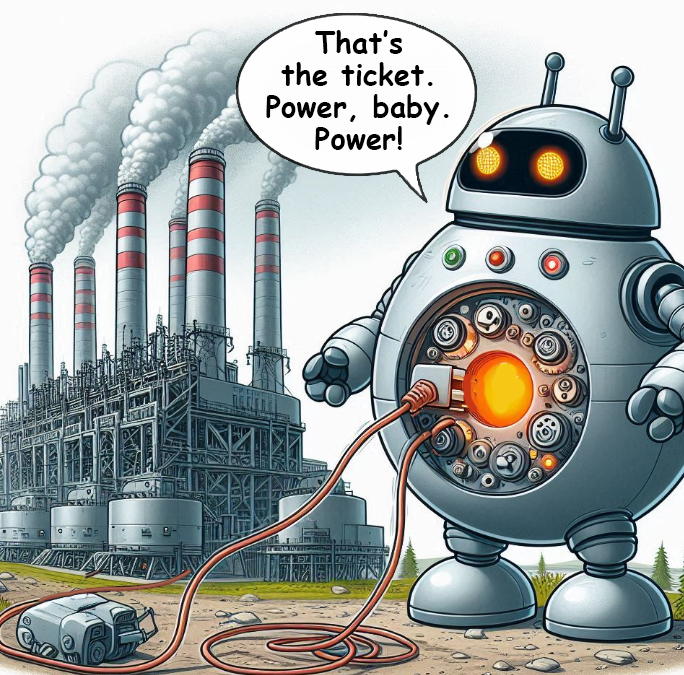
Thanks, MSFT Copilot. Good enough.
Neither these two articles nor the others I scanned focused on one key fact about Google’s saying green and driving snail darters to their fate. Google’s leadership team did not plan its energy strategy. In fact, my hunch is that no one paid any attention to how much energy Google’s AI activities were sucking down. Once the company shifted into Code Red or whatever consulting term craziness it used to label its frenetic response to the Microsoft OpenAI tie up, absolutely zero attention was directed toward the few big eyed tunas which might be taking their last dip.
Several observations:
- PR speak and green talk are like many assurances emitted by the Google. Talk is not action.
- The management processes at Google are disconnected from what happens when the wonky Code Red light flashes and the siren howls at midnight. Shouldn’t management be connected when the Tapanuli Orangutang could soon be facing the Big Ape in the sky?
- The AI energy consumption is not a result of AI. The energy consumption is a result of Googlers who do what’s necessary to respond to smart software. Step on the gas. Yeah, go fast. Endanger the Amur leopard.
Net net: Hey, Google, stand up and say, “My leadership team is responsible for the energy we consume.” Don’t blame your up-in-flames “green” initiative on software you invented. How about less PR and more focus on engineering more efficient data center and cloud operations? I know PR talk is easier, but buckle up, butter cup.
Stephen E Arnold, July 8, 2024
Will Google Charge for AI Features? Of Course
July 2, 2024
Will AI spur Google to branch out from its ad-revenue business model? Possibly, Dataconomy concludes in, “AI Is Draining Google’s Money and We May Be Charged for It.” Writer Eray Eliaç?k cites reporting from the Financial Times when stating:
“Google, the search engine used by billions, is considering charging for special features made possible by artificial intelligence (AI). This would be different from its usual practice of offering most of its services for free. Here’s what this could mean: Google might offer some cool AI-driven tools, like a smarter assistant or personalized search options, but only to those who pay for them. The regular Google search would stay free, but these extra features would come with a price tag, such as Gemini, SGE, and Image generation with AI and more.”
Would Google really make more charging for AI than on serving up ads alongside it? Perhaps it will do both?
Eliaç?k reminds us AI is still far from perfect. There are several reasons he does not address:
- Google faces a challenge to maintain its ad monopolies as investigations into its advertising business which has been running without interference for more than two decades
- AI is likely to be a sector with a big dog and a couple of mid sized dogs, and a bunch of French bulldogs (over valued and stubborn). Google wants to be the winner because it invented the transformer and now has to deal with the consequences of that decision. Some of the pretenders are likely to be really big dogs and capable of tearing off Googzilla’s tail
- Cost control is easy to talk about in MBA class and financial columns. In real online life, cost control is a thorny problem. No matter how much the bean counters squeeze, the costs of new gear, innovation, and fixing stuff when it flames out over the weekend blasts many IT budgets into orbit. Yep, even Google’s wizards face this problem.
Net net: Google will have little choice but find a way to monetize clicks, eye balls, customer service, cloud access, storage, and any thing that can be slapped with a price tag. Take that to MBA class.
Cynthia Murrell, July 2, 2024
-

- Subscribe to Beyond Search
Feature archive
News archive

-


