

Hewlett Packard and Autonomy: Search and $4 Billion
February 12, 2024
 This essay is the work of a dumb dinobaby. No smart software required.
More than a decade ago, Hewlett Packard acquired Autonomy plc. Autonomy was one of the first companies to deploy what I call “smart software.” The system used Bayesian methods, still quite new to many in the information retrieval game in the 1990s. Autonomy kept its method in a black box assigned to a company from which Autonomy licensed the functions for information processing. Some experts in smart software overlook BAE Systems’ activity in the smart software game. That effort began in the late 1990s if my memory is working this morning. Few “experts” today care, but the dates are relevant.
Between the date Autonomy opened for business in 1996 and HP’s decision to purchase the company for about $8 billion in 2011, there was ample evidence that companies engaged in enterprise search and allied businesses like legal work processes or augmented magazine advertising were selling for much less. Most of the companies engaged in enterprise search simply went out of business after burning through their funds; for example, Delphes and Entopia. Others sold at what I thought we inflated or generous prices; for example, Vivisimo to IBM for about $28 million and Exalead to Dassault for 135 million euros.
Then along comes HP and its announcement that it purchased Autonomy for a staggering $8 billion. I attended a search-related event when one of the presenters showed this PowerPoint slide:
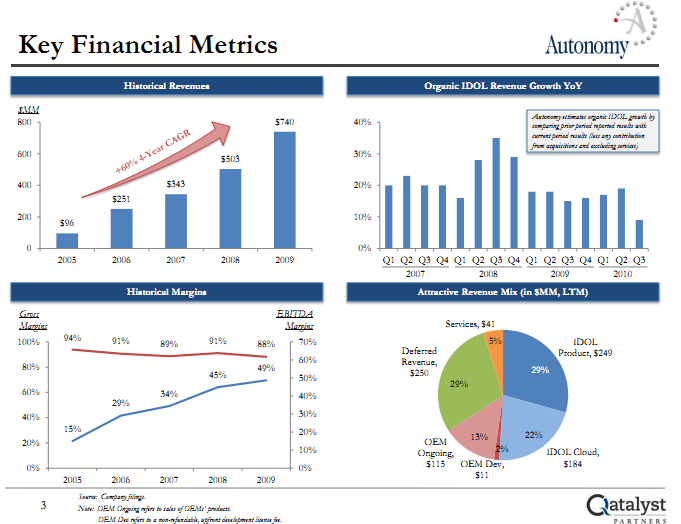
The idea was that Autonomy’s systems generated multiple lines of revenue, including a cloud service. The key fact on the presentation was that the search-and-retrieval unit was not the revenue rocket ship. Autonomy has shored up its search revenue by acquisition; for example, Soundsoft, Virage, and Zantaz. The company also experimented with bundling software, services, and hardware. But the Qatalyst slide depicted a rosy future because of Autonomy management’s vision and business strategy.
Did I believe the analysis prepared by Frank Quatrone’s team? I accepted some of the comments about the future, and I was skeptical about others. In the period from 2006 to 2012, it was becoming increasingly difficult to overcome some notable failures in enterprise search. The poster child from the problems was Fast Search & Transfer. In a nutshell, Fast Search retreated from Web search, shutting down its Google competitor AllTheWeb.com. The company’s engaging founder John Lervik told me that the future was enterprise search. But some Fast Search customers were slow in paying their bills because of the complexity of tailoring the Fast Search system to a client’s particular requirements. I recall being asked to comment about how to get the Fast Search system to work because my team used it for the FirstGov.gov site (now USA.gov) when the Inktomi solution was no longer viable due to procurement rule changes. Fast Search worked, but it required the same type of manual effort that the Vivisimo system required. Search-and-retrieval for an organization is not a one size fits all thing, a fact Google learned with its spectacular failure with its truly misguided Google Search Appliance product. Fast Search ended with an investigation related to financial missteps, and Microsoft stepped in in 2008 and bought the company for about $1.2 billion. I thought that was a wild and crazy number, but I was one of the lucky people who managed to get Fast Search to work and knew that most licensees would not have the resources or talent I had at my disposal. Working for the White House has some benefits, particularly when Fast Search for the US government was part of its tie up with AT&T. Thank goodness for my counterpart Ms. Coker. But $1.2 billion for Fast Search? That in my opinion was absolutely bonkers from my point of view. There were better and cheaper options, but Microsoft did not ask my opinion until after the deal was closed.
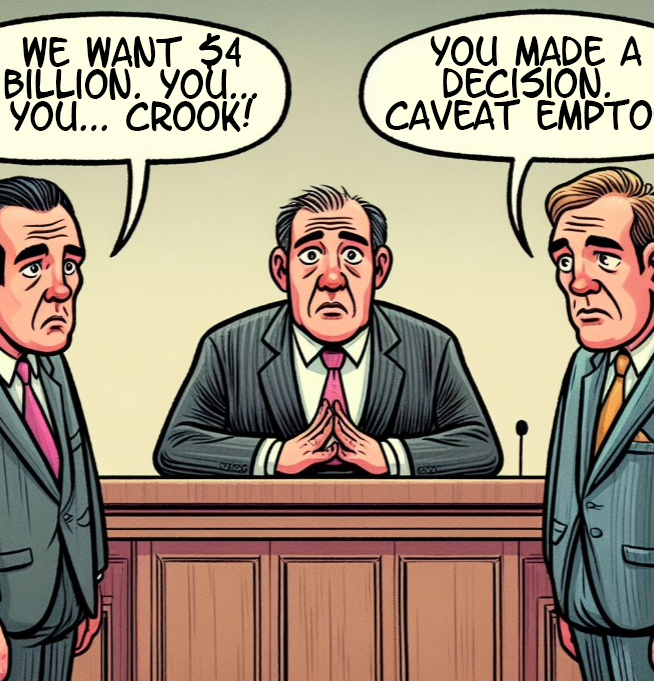
Everyone in the HP Autonomy matter keeps saying the same thing like an old-fashioned 78 RPM record stuck in a groove. Thanks, MSFT Copilot. You produced the image really “fast.” Plus, it is good enough like most search systems.
What is the Reuters’ news story adding to this background? Nothing. The reason is that the news story focuses on one factoid: “HP Claims $4 Billion Losses in London Lawsuit over Autonomy Deal.” Keep in mind that HP paid $11 billion for Autonomy plc. Keep in mind that was 10 times what Microsoft paid for Fast Search. Now HP wants $4 billion. Stripping away everything but enterprise search, I could accept that HP could reasonably pay $1.2 billion for Autonomy. But $11 billion made Microsoft’s purchase of Fast Search less nutso. Because, despite technical differences, Autonomy and Fast Search were two peas in a pod. The similarities were significant. The differences were technical. Neither company was poised to grow as rapidly as their stakeholders envisioned.
When open source search options became available, these quickly became popular. Today if one wants serviceable search-and-retrieval for an enterprise application one can use a Lucene / Solr variant or pick one of a number of other viable open source systems.
But HP bought Autonomy and overpaid. Furthermore, Autonomy had potential, but the vision of Mike Lynch and the resources of HP were needed to convert the promise of Autonomy into a diversified information processing company. Autonomy could have provided high value solutions to the health and medical market; it could have become a key player in the policeware market; it could have leveraged its legal software into a knowledge pipeline for eDiscovery vendors to license and build upon; and it could have expanded its opportunities to license Autonomy stubs into broader OpenText enterprise integration solutions.
But what did HP do? It muffed the bunny. Mr. Lynch exited and set up a promising cyber security company and spent the rest of his time in courts. The Reuters’ article states:
Following one of the longest civil trials in English legal history, HP in 2022 substantially won its case, though a High Court judge said any damages would be significantly less than the $5 billion HP had claimed. HP’s lawyers argued on Monday that its losses resulting from the fraud entitle it to about $4 billion.
If I were younger and had not written three volumes of the Enterprise Search Report and a half dozen books about enterprise search, I would write about the wild and crazy years for enterprise search, its hits, its misses, and its spectacular failures (Yes, Google, I remember the Google Search Appliance quite well.) But I am a dinobaby.
The net net is HP made a poor decision and now years later it wants Mike Lynch to pay for HP’s lousy analysis of the company, its management missteps within its own Board of Directors, and its decision to pay $11 billion for a company in a sector in which at the time simply being profitable was a Herculean achievement. So this dinobaby says, “Caveat emptor.”
Stephen E Arnold, February 12, 2024
The Next Big Thing in Search: A Directory of Web Sites
February 12, 2024
 This essay is the work of a dumb dinobaby. No smart software required.
In the early 1990s, an entrepreneur with whom I had worked in the 1980s convinced me to work on a directory of Web sites. Yahoo was popular at the time, but my colleague had a better idea. The good news is that our idea worked and the online service we built became part of the CMGI empire. Our service was absorbed by one of the leading finding services at the time. Remember Lycos? My partner and I do. Now the Web directory is back decades after those original Yahooligans and our team provided a useful way to locate a Web site.
“Search Chatbots? Pah, This Startup’s Trying on Yahoo’s Old Outfit of Web Directories” presents information about the utility of a directory of Web sites and captures some interesting observations about the findability service El Toco.
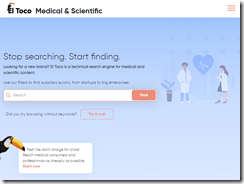
The innovator driving the directory concept is Thomas Chopping, a “UK based economist.” He made several observations in a recent article published by the British outfit The Register; for example:
“During the decades since it launched, we’ve been watching Google steadily trying to make search more predictive, by adding things like autocomplete and eventually instant answers,” Chopping told The Register. “This has the byproduct of increasing the amount of time users spend on their site, at the expense of visiting the underlying sources of the data.”
The founder of El Toco also notes:
It’s impossible to browse with conversational-style search tools, which are entirely focused on answering questions. “Right now, this is playing into the hands of Meta and TikTok, because it takes so much effort to find good quality websites via search engines that people stopped bothering.
El Taco wants to facilitate browsing, and the model is a directory listing. The user can browse and click. The system displays a Web site for the user to scan, read, or bookmark.
Another El Taco principle is:
“We don’t need the user’s personal data to work out which results to show, because the user can express this on their own. We don’t need AI to turn the search into a conversation, because this can be done with a few clicks of the user interface
The economist-turned-entrepreneur points out:
“Charging users for Web search is a model which clearly doesn’t work, thanks to Neeva for demonstrating that, so we allow adverts but if the users care they can go into a menu and simply switch them off.”
Will El Taco gain traction? My team and I have been involved in information retrieval for decades. From indexing information about nuclear facilities to providing some advice to an AI search start up a few months ago. I have learned that predicting what will become the next big thing in findability is quite difficult.
A number of interesting Web search solutions are available. Some are niche-focused like Biznar. Others are next-generation “phinding” services like Phind.com. Others are metasearch solutions like iSeek. Some are less crazy Google-style systems like Swisscows. And there are more coming every day.
Why? Let me share several observations or “learnings” from a half century of working in the information retrieval sector:
- People have different information needs and a one-size-fits-all search system is fraught with problems. One person wants to search for “pizza near me”. Another wants information about Dark Web secure chat services.
- Almost everyone considers themselves a good or great online searcher. Nothing could be further from the truth. Just ask the OSINT professionals at any intelligence conference.
- Search companies with some success often give in to budgeting for a minimally viable system, selling traffic or user data, and to dark patterns in pursuit of greater revenue.
- Finding information requires effort. Convenience, however, is the key feature of most finding systems. Microfilm is not convenient; therefore, it sucks. Looking at research data takes time and expertise; therefore, old-fashioned work sucks. Library work involving books is not for everyone; therefore, library research sucks. Only a tiny percentage of online users want to exert significant effort finding, validating, and making sense of information. Most people prefer to doom scroll or watch dance videos on a mobile device.
Net net: El Taco is worth a close look. I hope that editorial policies, human curation, and frequent updating become the new normal. I am just going to remain open minded. Information is an extremely potent tool. If I tell you human teeth can explode, do you ask for a citation? Do you dismiss the idea because of your lack of knowledge? Do you begin to investigate of high voltage on the body of a person who works around a 133 kV transmission line? Do you dismiss my statement because I am obviously making up a fact because everyone knows that electricity is 115 to 125 volts?
Unfortunately only subject matter experts operating within an editorial policy and given adequate time can figure out if a scientific paper contains valid data or made-up stuff like that allegedly crafted by the former presidents of Harvard and Stanford University and probably faculty at the university closest to your home.
Our 1992 service had a simple premise. We selected Web sites which contained valid and useful information. We did not list porn sites, stolen software repositories, and similar potentially illegally or harmful purveyors of information. We provided the sites our editors selected with an image file that was our version of the old Good Housekeeping Seal of Approval.

The idea was that in the early days of the Internet and Web sites, a parent or teacher could use our service without too much worry about setting off a porn storm or a parent storm. It worked, we sold, and we made some money.
Will the formula work today? Sure, but excellence and selectivity have been key attributes for decades. Give El Taco a look.
Stephen E Arnold, February 12, 2024
Can Googzilla Read a Manifesto and Exhibit Fear?
February 7, 2024
 This essay is the work of a dumb dinobaby. No smart software required.
Let’s think about scale. A start up wants to make a dent in Google’s search traffic. The start up has 2,000 words to blast away at the Google business model. Looking at the 2,000 words from a search tower buttressed by Google’s fourth quarter 2023 revenues of $86.31 billion (up 13% year over the same period in 2022). Does this look like a mismatch? I think it is more of a would-be competitor’s philosophical view of what should be versus what could be. Microsoft Bing is getting a clue as well.
Viewed from the perspective of a student of Spanish literature, the search start up may be today’s version of Don Quixote. The somewhat addled Alonso Quijano pronounced himself a caballero andante or what fans of chivalry in the US of A call a knight errant. What’s errant? In the 16th century, “errant” was self appointed, a bit like a journalism super star who road to fame on the outputs of the unfettered Twitter service and morphs into a pundit, a wizard, a seer.
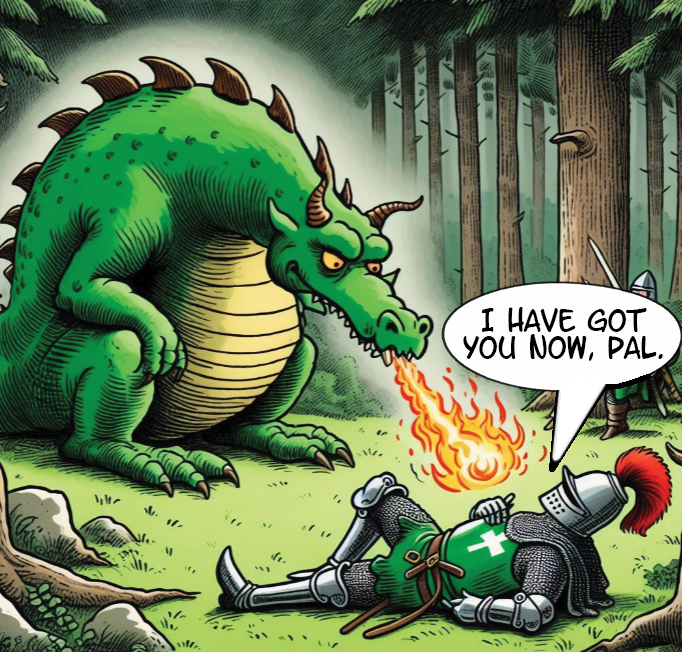
A modern-day Don Quixote finds himself in an interesting spot. The fire-breathing dragon is cooking its lunch. The bold knight explains that the big beastie is toast. Yeah. Thanks, MSFT Copilot Bing thing. Actually good enough today. Wow.
With a new handle, Don Quixote leaves the persona of Sr. Quijano behind and goes off the make Spain into a better place. The cause of Spanish angst is the windmill. The good Don tries to kill the windmills. But the windmills just keep on grinding grain. The good Don fails. He dies. Ouch!
I thought about the novel when I read “The Age of PageRank is Over [Manifesto].” The author champions a Web search start up called Kagi. The business model of Kagi is to get people to pay to gain access to the Kagi search system. The logic of the subscription model is that X number of people use online search. If our system can get a tiny percentage of those people to pay, we will be able to grow, expand, and deliver good search. The idea is that what Google delivers is crappy, distorted by advertisers who cough up big bucks, and designed to convert more and more online users to the One True Source of Information.
The “manifesto” says:
The websites driven by this business model became advertising and tracking-infested giants that will do whatever it takes to “engage” and monetize unsuspecting visitors. This includes algorithmic feeds, low-quality clickbait articles (which also contributed to the deterioration of journalism globally), stuffing the pages with as many ads and affiliate links as possible (to the detriment of the user experience and their own credibility), playing ads in videos every 45 seconds (to the detriment of generations of kids growing up watching these) and mining as much user data as possible.
These indeed are the attributes of Google and similar advertising-supported services. However, these attributes are what make stakeholders happy. These business model components are exactly what many other companies labor to implement and extend. Even law enforcement likes Google. At one conference I learned that 92 percent of cyber investigators rely on Google for information. If basic Google sucks, just use Google dorks or supplementary services captured in OSINT tools, browser add ins, and nifty search widgets.
Furthermore, switching from one search engine is not a matter of a single click. The no-Google approach requires the user pick a path through a knowledge mine field; for example:
- The user must know what he or she does invokes Google. Most users have no clue where Google fits in one’s online life. When told, those users do not understand.
- The user must identify or learn about one or more services that are NOT Google related.
- The user must figure out what makes one “search” service better than another, not an easy task even for alleged search experts
- The user must make a conscious choice to spit out cash
- The user must then learn how to get a “new” search system to deliver the results the user (trained and nudged by Google for 90 percent of online users in the US and Western Europe)
- The user must change his or her Google habit.
Now those six steps may not seem much of a problem to a person with the neurological wiring of Alonso Quijano or Don Quixote in more popular parlance. But from my experience in online and assorted tasks, these are tricky obstacles to scale.
Back to the Manifesto. I quote:
Nowadays when a user uses an ad-supported search engine, they are bound to encounter noise, wrong and misleading websites in the search results, inevitably insulting their intelligence and wasting their brain cycles. The algorithms themselves are constantly leading an internal battle between optimizing for ad revenue and optimizing for what the user wants.
My take on this passage is that users are supposed to know when they “encounter noise, wrong and misleading websites in the search results.” Okay, good luck with that. Convenience, the familiar, and easy everything raises electrified fences. Users just do what they have learned to do; they believe what they believe; and they accept what others are doing. Google has been working for more than two decades to develop what some call a monopoly. I think there are other words which are more representative of what Google has constructed. That’s why I don’t put on my armor, get a horse, and charge at windmills.
The Manifesto points to a new future for search; to wit:
In the future, instead of everyone sharing the same search engine, you’ll have your completely individual, personalized Mike or Julia or Jarvis – the AI. Instead of being scared to share information with it, you will volunteer your data, knowing its incentives align with yours. The more you tell your assistant, the better it can help you, so when you ask it to recommend a good restaurant nearby, it’ll provide options based on what you like to eat and how far you want to drive. Ask it for a good coffee maker, and it’ll recommend choices within your budget from your favorite brands with only your best interests in mind. The search will be personal and contextual and excitingly so!
Right.
However, here’s the reality of doing something new in search. An outfit like Google shows up. The slick representatives offer big piles of money. The start up sells out. What happens? Where’s Dodgeball now? Transformics? Oingo? The Google-type outfits buy threats or “innovators”. Google then uses what it requires. The result?
Google-type companies evolve and remain Googley. Search was a tough market before Google. My team built technology acquired by Lycos. We were fortunate. Would my team do Web search today? Nope. We are working on a different innovative system.
The impact of generative information retrieval applications is difficult to predict. New categories of software are already emerging; for example, the Arc AI search browser innovation. The software is novel, but I have not installed it. The idea is that it is smart and will unleash a finding agent. Maybe this will be a winner? Maybe.
The challenge is that Google and its “finding” functions are woven into many applications that don’t look like search. Examples range from finding an email to the new and allegedly helpful AI additions to Google Maps. If someone can zap Googzilla, my thought is that it will be like the extinction event that took care of its ancestors. One day, nice weather. The next day, snow. Is a traditional search engine enhanced with AI available as a subscription the killer asteroid? One of the techno feudalists will probably have the technology to deflect or vaporize the intruder. One cannot allow Googzilla to go hungry, can one?
Manifestos are good. The authors let off steam. Unfortunately getting sustainable revenues in a world of techno feudalists is, in my opinion, as difficult as killing a windmill. Someone will collect all the search manifestos and publish a book called “The End of Googzilla.” Yep, someday, just not at this time.
PS. There are angles to consider, just not the somewhat tired magazine subscription tactic. Does anyone care? Nah.
Stephen E Arnold, February 7, 2024
Discovering and Sharing Good Websites: No Social Media Required
February 6, 2024
 This essay is the work of a dumb dinobaby. No smart software required.
The Web has evolved over the last decade or two, and largely not in a good way. Blogger Jason Velazquez ponders, “Where Have All the Websites Gone?” Much of it, sadly, is the influence of SEO and Google—every year it gets harder to see the websites for the ads. But Velazquez points to another trend: the way we access web content has changed. Instead of curating it for ourselves and each other, we let social-media algorithms do the job. He points out:
“Somewhere between the late 2000’s aggregator sites and the contemporary For You Page, we lost our ability to curate the web. Worse still, we’ve outsourced our discovery to corporate algorithms. Most of us did it in exchange for an endless content feed. By most, I mean upwards of 90% who don’t make content on a platform as understood by the 90/9/1 rule. And that’s okay! Or, at least, it makes total sense to me. Who wouldn’t want a steady stream of dopamine shots? The rest of us, posters, amplifiers, and aggregators, traded our discovery autonomy for a chance at fame and fortune. Not all, but enough to change the social web landscape. But that gold at the end of the rainbow isn’t for us. ‘Creator funds’ pull from a fixed pot. It’s a line item in a budget that doesn’t change, whether one hundred or one million hands dip inside it. Executives in polished cement floor offices, who you’ll never meet, choose their winners and losers. And I’m guessing it’s not a meritocracy-based system. They pick their tokens, round up their shills, and stuff Apple Watch ads between them.”
But all is not lost. Interesting websites are still out there. Those of us who miss discovering and sharing them can start doing so again. To start, Velazquez offers a list of 13 of his favorites, so see the post for those. He also swapped out the Instagram link in his LinkedIn bio for links to several indie blogging platforms. He suggests readers can do something similar to share their favorite autonomous websites: artists, bloggers, aggregator sites run by humans (hi there!). Any “digital green spaces” will do. The websites have not gone anywhere. We just have to help each other find them.
Cynthia Murrell, February 6, 2024
Answering a Question Posed in an Essay about Search
February 1, 2024
 This essay is the work of a dumb dinobaby. No smart software required.
One of my research team asked me to take a look at an essay located at TomCritchlow.com. “Notes on Search and AI: More Questions Than Answers” reflects the angst generated by generative artificial intelligence. The burr under the saddle of many online users is festering. The plumbing of search is leaking and many of the thumb-typing generation are getting their Airbirds soaked. The discomfort is palpable. One of the people with whom I chat mentioned that some smart software outfits did not return the financial results the MBA whiz kid analysts expected. (Hello, Microsoft?)
The cited essay ends with a question:
Beep boop. What are you thinking about?
Since the author asked, I will answer the question to the best of my ability.

Traditional research skills are irrelevant. Hit the mobile and query, “Pizza near me.” Yep, that works, just not for the small restaurant or “fact”. Thanks, MSFT Copilot Bing thing. How is your email security today? Good enough I bet.
First, most of those who consider themselves good or great online searchers, the emergence of “smart” software makes it easy to find information. The problem is that for good or great online searchers, their ability to locate, verify, analyze, and distill “information” lags behind their own perception of their expertise. In general, the younger online searching expert, the less capable some are. I am basing this on the people with whom I speak in my online and in-person lectures. I am thinking that as these younger people grow older, the old-fashioned research skills will be either unknown, unfamiliar, or impossible. Information cannot be verified nor identified as authoritative. I am thinking that the decisions made based on actionable information is going to accelerate doors popping off aircraft, screwed up hospital patient information systems, and the melancholy of a young cashier when asked to make change by a customer who uses fungible money. Yes, $0.83 from $1.00 is $0.17. Honest.
Second, the jargon in the write up is fascinating. I like words similar to “precision,” “recall,” and “relevance,” among others. The essay explains the future of search with words like these:
Experiences, AI-generated and indexable
Interfaces, adaptive and just-in-time
LLM-powered alerts
Persistence
Predictability
Search quality
Signs
Slime helper
I am thinking that I cannot relate my concept of search and retrieval to the new world the write up references. I want to enter a query into a data base. For that database, I want to know what is in it, when it was updated, and why the editorial policies are for validity, timeliness, coverage, and other dinobaby concepts. In short, I want to do the research work using online when necessary. Other methods are usually required. These include talking to people, reading books, and using a range of reference tools at that endangered institution, the library.
Third, I am thinking that the equipment required for analytic thinking, informed analysis, and judicious decision making is either discarded or consigned to the junk heap.
In short, I am worried because I don’t want indexable experiences, black-box intermediaries, and predictability. I want to gather information and formulate my views based on content I can cite. That’s the answer, and it is not one the author of the essay is seeking. Too bad. Yikes, slime helper.
Stephen E Arnold, February 1, 2024
Why Stuff Does Not Work: Airplane Doors, Health Care Services, and Cyber Security Systems, Among Others
January 26, 2024
 This essay is the work of a dumb dinobaby. No smart software required.
“The Downward Spiral of Technology” stuck a chord with me. Think about building monuments in the reign of Cleopatra. The workers can check out the sphinx and giant stone blocks in the pyramids and ask, “What happened to the technology? We are banging with bronze and crappy metal compounds and those ancient dudes were zipping along with snappier tech.? That conversation is imaginary, of course.
The author of “The Downward Spiral” is focusing on less dusty technology, the theme might resonate with my made up stone workers. Modern technology lacks some of the zing of the older methods. The essay by Thomas Klaffke hit on some themes my team has shared whilst stuffing Five Guys’s burgers in their shark-like mouths.
Here are several points I want to highlight. In closing, I will offer some of my team’s observations on the outcome of the Icarus emulators.
First, let’s think about search. One cannot do anything unless one can find electronic content. (Lawyers, please, don’t tell me you have associates work through the mostly-for-show books in your offices. You use online services. Your opponents in court print stuff out to make life miserable. But electronic content is the cat’s pajamas in my opinion.)
Here’s a table from the Mr. Klaffke essay:
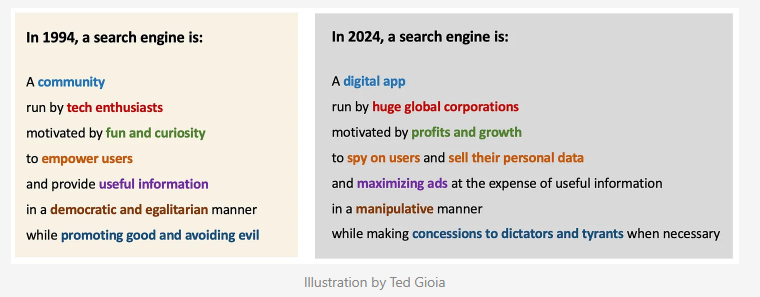
Two things are important in this comparison of the “old” tech and the “new” tech deployed by the estimable Google outfit. Number one: Search in Google’s early days made an attempt to provide content relevant to the query. The system was reasonably good, but it was not perfect. Messrs. Brin and Page fancy danced around issues like disambiguation, date and time data, date and time of crawl, and forward and rearward truncation. Flash forward to the present day, the massive contributions of Prabhakar Raghavan and other “in charge of search” deliver irrelevant information. To find useful material, navigate to a Google Dorks service and use those tips and tricks. Otherwise, forget it and give Swisscows.com, StartPage.com, or Yandex.com a whirl. You are correct. I don’t use the smart Web search engines. I am a dinobaby, and I don’t want thresholds set by a 20 year old filtering information for me. Thanks but no thanks.
The second point is that search today is a monopoly. It takes specialized expertise to find useful, actionable, and accurate information. Most people — even those with law degrees, MBAs, and the ability to copy and paste code — cannot cope with provenance, verification, validation, and informed filtering performed by a subject matter expert. Baloney does not work in my corner of the world. Baloney is not a favorite food group for me or those who are on my team. Kudos to Mr. Klaffke to make this point. Let’s hope someone listens. I have given up trying to communicate the intellectual issues lousy search and retrieval creates. Good enough. Nope.

Yep, some of today’s tools are less effective than modern gizmos. Hey, how about those new mobile phones? Thanks, MSFT Copilot Bing thing. Good enough. How’s the MSFT email security today? Oh, I asked that already.
Second, Mr Klaffke gently reminds his reader that most people do not know snow cones from Shinola when it comes to information. Most people assume that a computer output is correct. This is just plain stupid. He provides some useful examples of problems with hardware and user behavior. Are his examples ones that will change behaviors. Nope. It is, in my opinion, too late. Information is an undifferentiated haze of words, phrases, ideas, facts, and opinions. Living in a haze and letting signals from online emitters guide one is a good way to run a tiny boat into a big reef. Enjoy the swim.
Third, Mr. Klaffke introduces the plumbing of the good-enough mentality. He is accurate. Some major social functions are broken. At lunch today, I mentioned the writings about ethics by Thomas Dewey and William James. My point was that these fellows wrote about behavior associated with a world long gone. It would be trendy to wear a top hat and ride in a horse drawn carriage. It would not be trendy to expect that a person would work and do his or her best to do a good job for the agreed-upon wage. Today I watched a worker who played with his mobile phone instead of stocking the shelves in the local grocery store. That’s the norm. Good enough is plenty good. Why work? Just pay me, and I will check out Instagram.
I do not agree with Mr. Klaffke’s closing statement; to wit:
The problem is not that the “machine” of humanity, of earth is broken and therefore needs an upgrade. The problem is that we think of it as a “machine”.
The problem is that worldwide shared values and cultural norms are eroding. Once the glue gives way, we are in deep doo doo.
Here are my observations:
- No entity, including governments, can do anything to reverse thousands of years of cultural accretion of norms, standards, and shared beliefs.
- The vast majority of people alive today are reverting back to some fascinating behaviors. “Fascinating” is not a positive in the sense in which I am using the word.
- Online has accelerated the stress on social glue; smart software is the turbocharger of abrupt, hard-to-understand change.
Net net: Please, read Mr. Klaffke’s essay. You may have an idea for remediating one or more of today’s challenges.
Stephen E Arnold, January 25, 2024
Search Market Data: One Click to Oblivion Is Baloney, Mr. Google
January 24, 2024
 This essay is the work of a dumb dinobaby. No smart software required.
Do you remember the “one click away” phrase. The idea was and probably still is in the minds of some experts that any user can change search engines with a click. (Eric Schmidt, the adult once in charge of the Google) also suggested that he is kept awake at night worrying about Qwant. I know? Qwant what?
 “I have all the marbles,” says the much loved child. Thanks, MSFT second string Copilot Bing thing. Good enough.
I read an interesting factoid. I don’t know if the numbers are spot on, but the general impression of the information lines up with what my team and I have noted for decades. The relevance champions at Search Engine Roundtable published “Report: Bing Gained Less Than 1% Market Share Since Adding Bing Chat.”
Here’s a passage I found interesting:
Bloomberg reported on the StatCounter data, saying, “But Microsoft’s search engine ended 2023 with just 3.4% of the global search market, according to data analytics firm StatCounter, up less than 1 percentage point since the ChatGPT announcement.”
There’s a chart which shows Google’s alleged 91.6 percent Web search market share. I love the precision of a point six, don’t you? The write up includes a survey result suggesting that Bing would gain more market share.
Yeah, one click away. Oh, Qwant.com is still on line at https://www.qwant.com/. Rest easy, Google.
Stephen E Arnold, January 24, 2024
How Do You Foster Echo Bias, Not Fake, But Real?
January 24, 2024
 This essay is the work of a dumb dinobaby. No smart software required.
Research is supposed to lead to the truth. It used to when research was limited and controlled by publishers, news bureaus, and other venues. The Internet liberated information access but it also unleashed a torrid of lies. When these lies are stacked and manipulated by algorithms, they become powerful and near factual. Nieman Labs relates how a new study shows the power of confirmation in, “Asking People ‘To Do The Research’ On Fake News Stories Makes Them Seem More Believable, Not Less.”
Nature reported on a paper by Kevin Aslett, Zeve Sanderson, William Godel, Nathaniel Persily, Jonathan Nagler, and Joshua A. Tucker. The paper abstract includes the following:
Here, across five experiments, we present consistent evidence that online search to evaluate the truthfulness of false news articles actually increases the probability of believing them. To shed light on this relationship, we combine survey data with digital trace data collected using a custom browser extension. We find that the search effect is concentrated among individuals for whom search engines return lower-quality information. Our results indicate that those who search online to evaluate misinformation risk falling into data voids, or informational spaces in which there is corroborating evidence from low-quality sources. We also find consistent evidence that searching online to evaluate news increases belief in true news from low-quality sources, but inconsistent evidence that it increases belief in true news from mainstream sources. Our findings highlight the need for media literacy programs to ground their recommendations in empirically tested strategies and for search engines to invest in solutions to the challenges identified here.”
All of the tests were similar in that they asked participants to evaluate news articles that had been rated “false or misleading” by professional fact checkers. They were asked to read the articles, research and evaluate the stories online, and decide if the fact checkers were correct. Controls were participants who were asked not to research stories.
The tests revealed that searching online increase misinformation belief. The fifth test in the study explained that exposure to lower-quality information in search results increased the probability of believing in false news.
The culprit for bad search engine results is data voids akin to rabbit holes of misinformation paired with SEO techniques to manipulate people. People with higher media literacy skills know how to better use search engines like Google to evaluate news. Poor media literacy people don’t know how to alter their search queries. Usually they type in a headline and their results are filled with junk.
What do we do? We need to revamp media literacy, force search engines to limit number of paid links at the top of results, and stop chasing sensationalism.
Whitney Grace, January 24, 2024
Kagi For-Fee Search: Comments from a Thread about Search
January 2, 2024
 This essay is the work of a dumb dinobaby. No smart software required.
Comparisons of search engine performance are quite difficult to design, run, and analyze. In the good old days when commercial databases reigned supreme, special librarians could select queries, refine them, and then run those queries via Dialog, LexisNexis, DataStar, or another commercial search engine. Examination of the results were tabulated and hard copy print outs on thermal paper were examined. The process required knowledge of the search syntax, expertise in query shaping, and the knowledge in the minds of the special librarians performing the analysis. Others were involved, but the work focused on determining overlap among databases, analysis of relevance (human and mathematical), and expertise gained from work in the commercial database sector, academic training, and work in a special library.
Who does that now? Answer: No one. With this prefatory statement, let’s turn our attention to “How Bad Are Search Results? Let’s Compare Google, Bing, Marginalia, Kagi, Mwmbl, and ChatGPT.” Please, read the write up. The guts of the analysis, in my opinion, appear in this table:
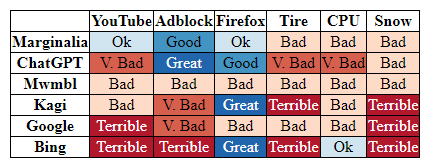
The point is that search sucks. Let’s move on. The most interesting outcome from this write up from my vantage point is the comments in the Hacker News post. What I want to do is highlight observations about Kagi.com, a pay-to-use Web search service. The items I have selected make clear why starting and building sustainable revenue from Web search is difficult. Furthermore, the comments I have selected make clear that without an editorial policy, specific information about the corpus, its updating, and content acquisition method — evaluation is difficult.
Long gone are the days of precision and recall, and I am not sure most of today’s users know or care. I still do, but I am a dinobaby and one of those people who created an early search-related service called The Point (Top 5% of the Internet), the Auto Channel, and a number of other long-forgotten Web sites that delivered some type of findability. Why am I roadkill on the information highway? No one knows or cares about the complexity of finding information in print or online. Sure, some graduate students do, but are you aware that the modern academic just makes up or steals other information; for instance, the former president of Stanford University.l
Okay, here are some comments about Kagi.com from Hacker News. (Please, don’t write me and complain that I am unfair. I am just doing what dinobabies with graduate degrees do — Provide footnotes)
hannasanario: I’m not able to reproduce the author’s bad results in Kagi, at all. What I’m seeing when searching the same terms is fantastic in comparison. I don’t know what went wrong there. Dinobaby comment: Search results, in the absence of editorial policies and other basic information about valid syntax means subjectivity is the guiding light. Remember that soap operas were once sponsored influencer content.
Semaphor: This whole thread made me finally create a file for documenting bad searches on Kagi. The issue for me is usually that they drop very important search terms from the query and give me unrelated results. Dinobaby comment: Yep, editorial functions in results, and these are often surprises. But when people know zero about a topic, who cares? Not most users.
Szundi: Kagi is awesome for me too. I just realize using Google somewhere else because of the sh&t results. Dinobaby comment: Ah, the Google good enough approach is evident in this comment. But it is subjective, merely an opinion. Just ask a stockholder. Google delivers, kiddo.
Mrweasel: Currently Kagi is just as dependent on Google as DuckDuckGo is on Bing. Dinobaby comment: Perhaps Kagi is not communicating where content originates, how results are generated, and why information strikes Mrweasel as “dependent on Google. Neeva was an outfit that wanted to go beyond Google and ended up, after marketing hoo hah selling itself to some entity.
Fenaro: Kagi should hire the Marginalia author. Dinobaby comment: Staffing suggestions are interesting but disconnected from reality in my opinion.
ed109685: Kagi works because there is no incentive for SEO manipulators to target it since their market share is so small. Dinobaby comment: Ouch, small.
shado: I became a huge fan of Kagi after seeing it on hacker news too. It’s amazing how good a search engine can be when it’s not full of ads. Dinobaby comment: A happy customer but no hard data or examples. Subjectivity in full blossom.
yashasolutions: Kagi is great… So I switch recently to Kagi, and so far it’s been smooth sailing and a real time saver. Dinobaby comment: Score another happy, paying customer for Kagi.
innocentoldguy: I like Kagi and rarely use anything else. Kagi’s results are decent and I can blacklist sites like Amazon.com so they never show up in my search results. Dionobaby comment: Another dinobaby who is an expert about search.
What does this selection of Kagi-related comments reveal about Web search? Here’s snapshot of my notes:
- Kagi is not marketing its features and benefits particularly well, but what search engine is? With Google sucking in more than 90 percent of the query action, big bucks are required to get the message out. This means that subscriptions may be tough to sell because marketing is expensive and people sign up, then cancel.
- There is quite a bit of misunderstanding among “expert” searchers like the denizens of Hacker News. The nuances of a Web search, money supported content, metasearch, result matching, etc. make search a great big cloud of unknowing for most users.
- The absence of reproducible results illustrates what happens when consumerization of search and retrieval becomes the benchmark. The pursuit of good enough results in loss of finding functionality and expertise.
Net net: Search sucks. Oh, wait, I used that phrase in an article for Barbara Quint 35 years ago.
PS. Mwmbl is at https://mwmbl.or in case you are not familiar with the open source, non profit search engine. You have to register, well, because…
Stephen E Arnold, January 2, 2024
A Dinobaby Misses Out on the Hot Searches of 2023
December 28, 2023
 This essay is the work of a dumb dinobaby. No smart software required.
I looked at “Year in Search 2023.” I was surprised at how out of the flow of consumer information I was. “Out of the flow” does not not capture my reaction to the lists of the news topics, dead people, and songs I was. Do you know much about Bizarrap? I don’t. More to the point, I have never heard of the obviously world-class musician.
Several observations:
First, when people tell me that Google search is great, I have to recalibrate my internal yardsticks to embrace queries for entities unrelated to my microcosm of information. When I assert that Google search sucks, I am looking for information absolutely positively irrelevant to those seeking insight into most of the Google top of the search charts. No wonder Google sucks for me. Google is keeping pace with maps of sports stadia.
Second, as I reviewed these top searches, I asked myself, “What’s the correlation between advertisers’ spend and the results on these lists? My idea is that a weird quantum linkage exists in a world inhabited by incentivized programmers, advertisers, and the individuals who want information about shirts. Its the game rigged? My hunch is, “Yep.” Spooky action at a distance I suppose.
Third, from the lists substantive topics are rare birds. Who is looking for information about artificial intelligence, precision and recall in search, or new approaches to solving matrix math problems? The answer, if the Google data are accurate and not a come on to advertisers, is almost no one.
As a dinobaby, I am going to feel more comfortable in my isolated chamber in a cave of what I find interesting. For 2024, I have steeled myself to exist without any interest in Ginny & Georgia, FIFTY FIFTY, or papeda.
I like being a dinobaby. I really do.
Stephen E Arnold, December 28, 2023
-

- Subscribe to Beyond Search
Feature archive
News archive

-


